
Ohio Background Check Laws for Employers: 2026 Compliance Guide
Hiring in Ohio? First, learn which laws shape every background check you order.
This guide covers the federal FCRA, key Ohio Revised Code sections, lookback limits, and the agencies that enforce each rule.
BCS Background Screening LLC wrote it for HR teams, business owners, and recruiters who screen Ohio applicants.
- BCI checks: ORC 109.572
- Ban the box: ORC 9.73
- Sealed records: ORC 2953.34
- Driving records: ORC 4501.27
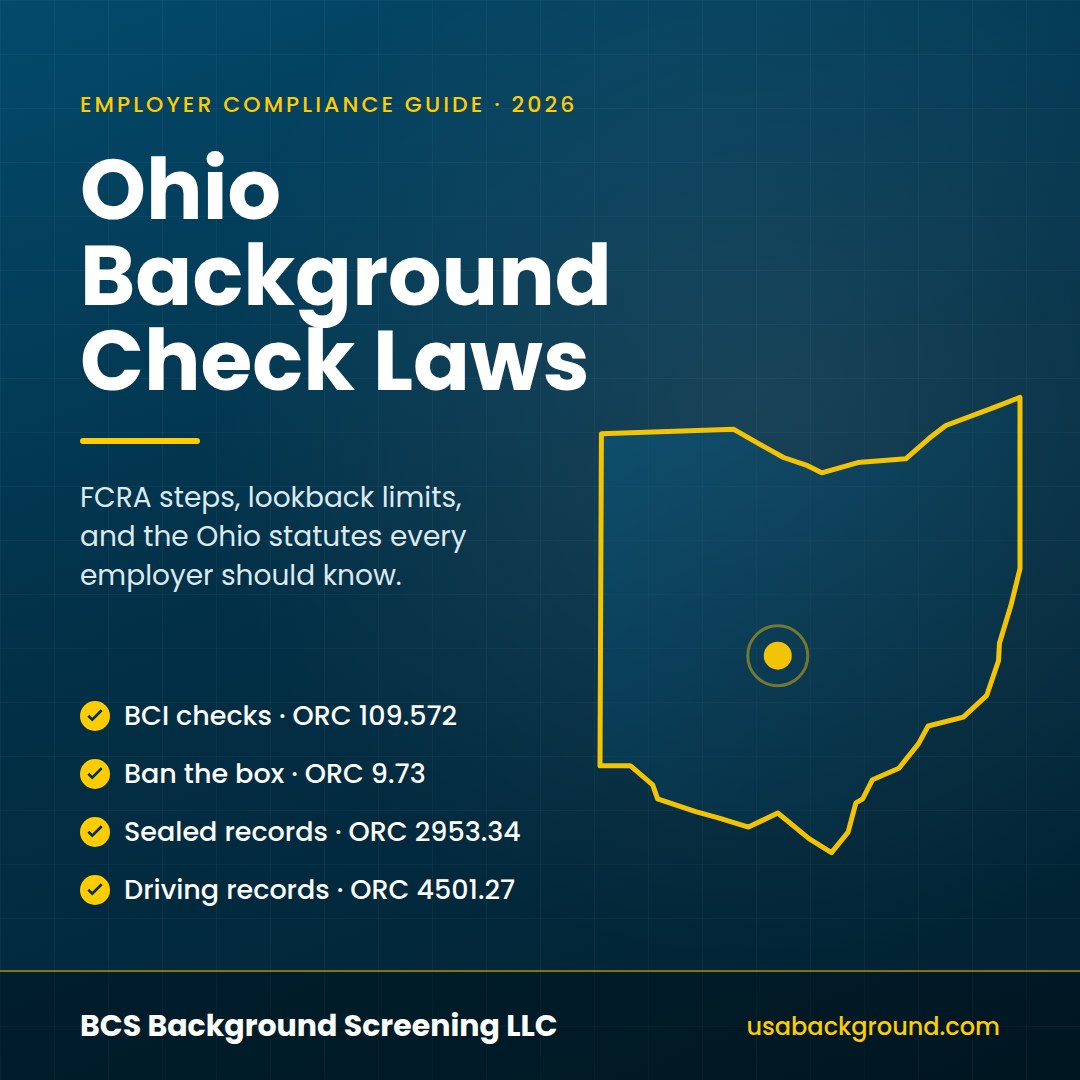
Ohio Background Check Laws at a Glance
Ohio has no stand-alone state version of the FCRA for employment screening.
Instead, federal law sets the core consumer reporting rules.
Ohio statutes then add rules for public job applications, sealed records, driving data, and mandated checks.
Use this table as a quick reference before you screen.
| Topic | Governing Law | What It Does | Administered By |
|---|---|---|---|
| Background check reports | Fair Credit Reporting Act, 15 U.S.C. § 1681 | Requires disclosure, written consent, and adverse action notices | CFPB and FTC |
| State criminal records checks | ORC 109.572 | Authorizes BCI fingerprint checks for mandated positions | Ohio Attorney General, Bureau of Criminal Investigation (BCI) |
| Public-sector ban the box | ORC 9.73 | Bars criminal history questions on public job applications | Each state agency and political subdivision |
| Sealed and expunged records | ORC 2953.32 and 2953.34 | Limits questions about sealed cases | Ohio courts; BCI updates the records |
| Certificate of Qualification for Employment | ORC 2953.25 | Grants negligent hiring immunity to employers | ODRC reviews; courts of common pleas issue |
| Driving records | ORC 4501.27 | Limits release of personal data in BMV records | Ohio BMV, Department of Public Safety |
| Employment discrimination | ORC 4112.02 | Bars discrimination by employers with four or more employees | Ohio Civil Rights Commission |
| Marijuana and drug testing | ORC 3796.28 | Preserves drug-free workplace and testing policies | Division of Cannabis Control, Ohio Department of Commerce |
| Salary history bans | Cincinnati, Toledo, Columbus, and Cleveland ordinances | Bars pay history questions for employers with 15+ local employees | City commissions and boards |
| E-Verify for construction | ORC 4151.01–4151.07 | Requires E-Verify for nonresidential construction hires | Ohio Attorney General |
Federal FCRA Rules Every Ohio Employer Must Follow
The Fair Credit Reporting Act governs every background report you buy from a consumer reporting agency.
Today, the Consumer Financial Protection Bureau and the Federal Trade Commission share enforcement.
The joint FTC and EEOC guide, Background Checks: What Employers Need to Know, summarizes your duties.
Follow these four steps for every Ohio applicant.
- 1
Give a Stand-Alone Disclosure
Provide a clear written notice that you may obtain a background report. Keep it separate from the job application.
- 2
Get Written Authorization
Obtain the applicant’s signed consent before you order any report. Electronic signatures work well here.
- 3
Send a Pre-Adverse Action Notice
Share a copy of the report and the CFPB Summary of Rights. Then wait a reasonable time before you decide.
- 4
Issue the Adverse Action Notice
Name the screening agency. State that it did not make the decision. Explain the applicant’s dispute rights.
Additionally, you must certify to your screening company that you will follow these rules.
Ohio adds no separate state disclosure form, so one FCRA-compliant process covers your Ohio hires.
How Far Back Can an Ohio Background Check Go?
Ohio has no state law that caps how far back a criminal background check may reach.
Therefore, federal lookback rules control most employment reports.
Section 605 of the FCRA, codified at 15 U.S.C. § 1681c, sets those limits.
Arrests, charges, and other non-conviction records drop off after seven years.
Criminal convictions may appear on reports no matter how old they are.
The seven-year cap does not apply to jobs paying $75,000 or more a year.
Sealed and expunged Ohio cases should never appear on an employment report.
Ohio’s record sealing law also shortens the practical lookback window.
Under ORC 2953.32, many people may apply to seal eligible records soon after final discharge.
The wait is six months for minor misdemeanors.
Most other misdemeanors and fourth- or fifth-degree felonies require one year.
Third-degree felonies carry a three-year wait.
Meanwhile, several Ohio industry statutes set their own disqualifying offense lists and time periods.
Ban the Box in Ohio: Public Employers Only
Ohio’s statewide ban-the-box law is ORC 9.73, created by House Bill 56.
It took effect March 23, 2016.
The law bars public employers from asking about criminal history on job application forms.
State agencies, counties, cities, and townships must comply.
However, a public employer may still run a background check later in the hiring process.
The application may also note any law that disqualifies certain offenders from a position.
Many Ohio localities adopted similar policies for their own government jobs.
Local examples include Akron, Alliance, Canton, Cincinnati, Cleveland, Dayton, Massillon, Newark, Warren, and Youngstown.
Cuyahoga, Franklin, Hamilton, Lucas, Stark, and Summit counties follow similar rules.
Private employers face no statewide ban-the-box mandate today.
Still, lawmakers keep trying.
Senate Bill 143 of the 136th General Assembly would extend the application ban to private employers.
At our September 2026 review, the bill had not cleared its Senate committee.
Sealed Records, Expungement, and the CQE
Ohio law protects people whose cases a court has sealed or expunged.
Under ORC 2953.34, employers may ask only about convictions that remain unsealed.
An exception applies when a question bears a direct and substantial relationship to the position.
If you ask improperly, the applicant may answer as if the case never happened.
Moreover, you may not take adverse action based on that answer.
In addition, you may not question applicants about expunged convictions at all.
Ohio courts decide sealing and expungement applications, and BCI then updates its criminal history files.
The Certificate of Qualification for Employment
The CQE helps qualified people with criminal records return to work.
The Ohio Department of Rehabilitation and Correction reviews each petition.
Next, the county court of common pleas grants or denies it.
Employers gain real protection too.
ORC 2953.25(G)(2) grants immunity from negligent hiring claims when you knew of the certificate.
Consequently, a CQE supports a confident, well-documented hiring decision.
Ohio BCI and FBI Checks Under ORC 109.572
ORC 109.572 authorizes the Bureau of Criminal Investigation to run state criminal records checks.
BCI operates within the Ohio Attorney General’s office.
Many statutes require these fingerprint checks for sensitive jobs.
Applicants usually submit fingerprints electronically through an approved WebCheck vendor.
BCI can also add an FBI check when the law requires one.
The Ohio Attorney General background check FAQs explain vendors, forms, and fingerprint options.
When no statute mandates a fingerprint check, a name-based search offers a faster option.
For example, our Ohio real-time statewide criminal search helps you screen applicants quickly.
Pair it with county court searches for deeper coverage.
Never replace a legally mandated BCI check with a commercial search, though.
Ohio Driving Record Checks for Employers
Ohio protects personal data in motor vehicle records under ORC 4501.27.
The statute mirrors the federal Driver’s Privacy Protection Act.
The Ohio Bureau of Motor Vehicles, part of the Department of Public Safety, administers it.
Employers may obtain records for permitted purposes, such as verifying a commercial driver’s license holder.
Always collect FCRA consent first when a screening company pulls the record.
An Ohio BMV driving record abstract covers three years of moving violations, crashes, and suspensions.
Motor carriers also follow FMCSA rule 49 CFR 391.23.
That rule requires a three-year driving history from every state that licensed the driver.
BCS Background Screening LLC delivers fast Motor Vehicle Records for delivery, trucking, sales, and CDL positions.
Ohio Industries With Mandatory Background Checks
Several Ohio statutes require BCI checks before hiring.
Each one ties back to ORC 109.572.
Review these cards to see whether your roles qualify.
Schools
School districts must check applicants for jobs involving the care, custody, or control of children.
Foster Care and Adoption
Agencies must check foster caregivers, adoption applicants, and adults living in their homes.
Hospice Care
Hospice care programs must check applicants for direct-care positions.
Nursing Homes and Residential Care
Long-term care facilities must check applicants for direct-care positions.
Developmental Disabilities
Developmental disabilities employers must check applicants before hiring.
Private Security
Security guard companies and their employees need BCI checks for licensing and registration.
Other Ohio Hiring Laws That Affect Screening
Discrimination and Individualized Assessment
ORC 4112.02 prohibits discrimination by Ohio employers with four or more employees.
The Ohio Civil Rights Commission enforces it.
Blanket criminal record bans can create disparate impact risk.
Therefore, follow the EEOC arrest and conviction records guidance.
Weigh the offense, the time passed, and the job duties.
Marijuana and Drug Testing
Ohio voters legalized adult-use marijuana in 2023.
Even so, ORC 3796.28 preserves employer rights.
You may keep drug-free workplace, testing, and zero-tolerance policies.
You may also refuse to hire applicants who violate them.
Senate Bill 56 updated this section effective March 20, 2026.
The Division of Cannabis Control oversees the state program.
Salary History Bans in Four Ohio Cities
No statewide salary history ban exists.
However, four cities restrict pay history questions for employers with 15 or more local employees.
Cincinnati and Toledo also require covered employers to provide a pay scale on request after a conditional offer.
- Cincinnati: effective March 13, 2020 (KMK Law overview).
- Toledo: effective June 25, 2020 (Littler overview).
- Columbus: effective March 1, 2024, with salary range postings enforced from January 1, 2027 (Littler overview).
- Cleveland: effective October 27, 2025, with pay range posting rules (McDonald Hopkins overview).
Credit Checks
Ohio sets no specific limits on employment credit checks.
Nevertheless, FCRA disclosure, consent, and adverse action rules still apply.
E-Verify for Construction Employers
Ohio’s E-Verify Workforce Integrity Act, ORC 4151.01–4151.07, took effect March 20, 2026.
It covers nonresidential construction contractors, subcontractors, and labor brokers.
They must verify each employee hired for a nonresidential construction project through E-Verify.
They must also keep each verification for three years after hire or one year after separation, whichever is later.
In addition, they may not keep an employee after a final nonconfirmation.
The attorney general enforces the law with civil penalties.
However, Ohio sets no E-Verify mandate for other private employers.
Ohio Employment Screening Services
BCS Background Screening LLC offers FCRA-compliant searches built for Ohio employers.
Ohio Statewide Criminal Search
Real-time statewide criminal records for fast pre-hire decisions.
County Criminal Court Search
Direct searches of Ohio county courts for the most complete results.
Federal Criminal Search
Federal district court records for fraud, tax, and interstate offenses.
Nationwide Background Check
SSN trace, national criminal database, sex offender registry, and watchlists.
Motor Vehicle Records
Driving histories for delivery, trucking, sales, and CDL positions.
Mobile Applicant Screening
Applicants e-sign FCRA disclosures and enter their own data from any phone.
Ohio Employer Background Check Checklist
Use this checklist to keep every Ohio hire compliant and consistent.
- Confirm whether a statute requires a BCI or FBI fingerprint check under ORC 109.572.
- Remove criminal history questions from public-sector applications under ORC 9.73.
- Ask only about unsealed convictions that relate to the job, per ORC 2953.34.
- Give a stand-alone FCRA disclosure and collect written authorization.
- Apply the seven-year non-conviction limit unless the job pays $75,000 or more.
- Pull motor vehicle records for driving roles and follow 49 CFR 391.23 for CDL drivers.
- Complete an individualized assessment before rejecting anyone for a record.
- Send pre-adverse and adverse action notices, then keep records of each step.
Ohio Employment Screening Law FAQs
Employers ask these questions most often about Ohio background checks.
Does Ohio have its own version of the federal Fair Credit Reporting Act?
No. Ohio has not enacted a stand-alone consumer reporting law for employment screening.
Instead, Ohio employers follow the federal Fair Credit Reporting Act, 15 U.S.C. § 1681 et seq.
The law requires a stand-alone disclosure, written authorization, and pre-adverse and adverse action notices.
The Consumer Financial Protection Bureau and the Federal Trade Commission administer and enforce it.
Ohio still layers on state rules, such as ORC 4112.02, which the Ohio Civil Rights Commission enforces.
What Ohio law governs criminal background checks for employment?
Ohio Revised Code 109.572 governs state criminal records checks.
It authorizes the Bureau of Criminal Investigation to search Ohio criminal history files by fingerprint.
BCI operates within the Ohio Attorney General’s office.
Many industries, including schools, nursing homes, and child care, must use these checks.
BCI can add an FBI check when federal or state law requires one.
Does Ohio have a ban-the-box law for private employers?
No. Ohio’s ban-the-box law, ORC 9.73, applies only to public employers.
It bars criminal history questions on public job applications and took effect March 23, 2016.
Each state agency and political subdivision must follow it.
Local ordinances in cities such as Cleveland and Cincinnati also cover public jobs only.
Senate Bill 143 would extend the rule to private employers, but it has not passed.
Can Ohio employers ask applicants about sealed or expunged records?
Generally, no. ORC 2953.34 lets employers ask only about convictions that remain unsealed.
An exception applies when a question has a direct and substantial relationship to the position.
Applicants may answer improper questions as if the sealed case never occurred.
Ohio courts grant sealing and expungement under ORC 2953.32, and BCI updates its records.
How far back can a criminal background check go in Ohio?
Ohio has no state lookback limit, so the federal FCRA applies.
Under 15 U.S.C. § 1681c, non-conviction records drop off after seven years.
Convictions can appear without a time limit.
The seven-year cap does not apply to jobs paying $75,000 or more.
Also, sealed records under ORC 2953.32 should not appear at all.
The CFPB and FTC enforce these reporting limits.
What law governs driving record checks for Ohio employers?
ORC 4501.27 governs access to personal information in Ohio motor vehicle records.
It mirrors the federal Driver’s Privacy Protection Act, 18 U.S.C. § 2721.
The Ohio Bureau of Motor Vehicles, within the Department of Public Safety, administers it.
Employers may verify commercial driver’s license holders under this law.
Motor carriers must also obtain a three-year driving history under 49 CFR 391.23.
Are Ohio employers protected when they hire someone with a criminal record?
Yes, in some cases. ORC 2953.25 created the Certificate of Qualification for Employment.
The certificate gives employers immunity from negligent hiring claims when they knew of it.
The Ohio Department of Rehabilitation and Correction reviews petitions.
A county court of common pleas then decides whether to issue the certificate.
Start Screening Ohio Applicants Today
Open a free business account in minutes and order your first search today.
Every user account includes optional Multiple Authentication Factor (MAF) for added security.
Disclaimer: This page provides general information, not legal advice. Laws change often. Consult an Ohio employment attorney before you change hiring policies. Last reviewed October 1, 2026.