
Kentucky Background Check Laws for Employers
Kentucky has no state version of the FCRA. Instead, federal law, a handful of Kentucky statutes and two local rules shape every hire.
This guide maps each rule to its statute and the agency that enforces it. As a result, you can screen fast and stay compliant.
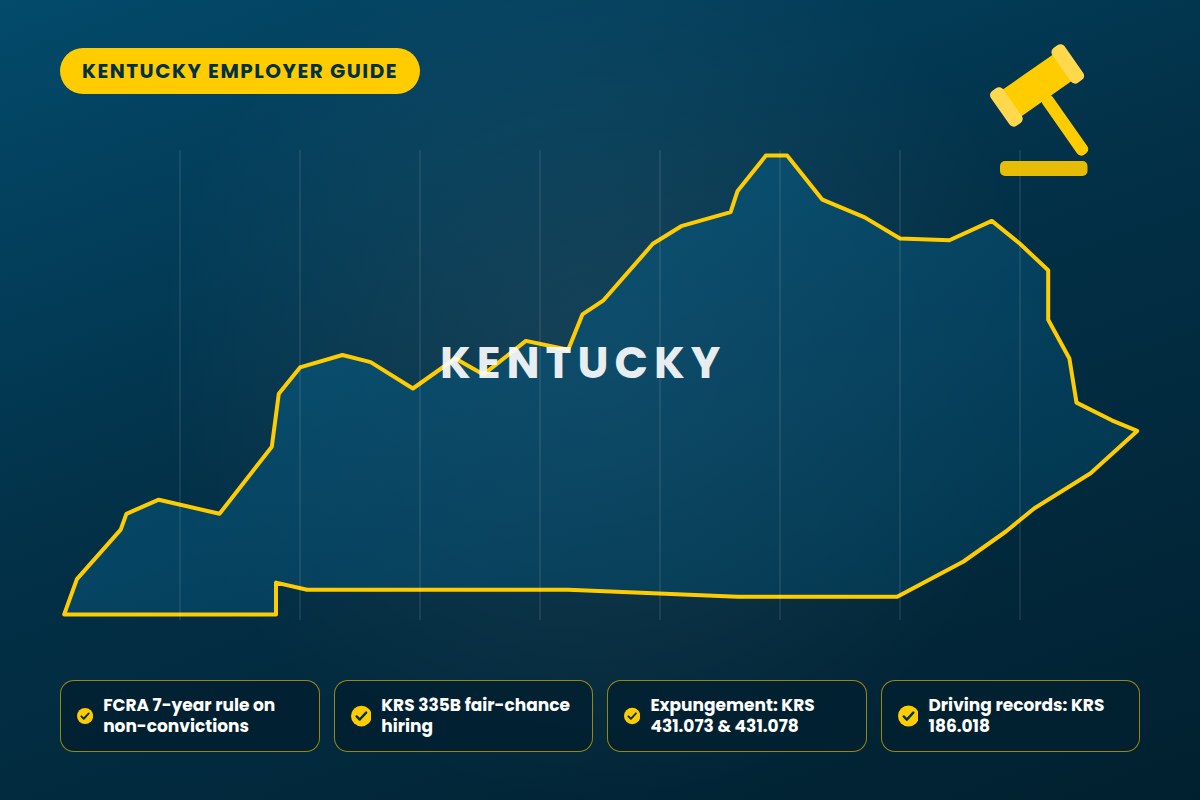
Kentucky Employment Screening Laws and the Agencies Behind Them
Kentucky employers follow a layered set of rules.
First, the federal Fair Credit Reporting Act governs every report you buy from a background check company.
Next, Kentucky statutes cover public jobs, expungement, driving records, schools and health care.
Finally, Louisville Metro adds a fair-chance rule for its own hiring and its vendors.
The tables below name each law, explain it briefly and identify the agency that administers it.
Criminal record and hiring laws
| Statute or rule | What it does | Administering agency |
|---|---|---|
| Fair Credit Reporting Act, 15 U.S.C. §1681 et seq. | Requires disclosure, written authorization and two-step adverse action. It also caps reporting of non-convictions at seven years. | Federal Trade Commission and Consumer Financial Protection Bureau |
| KRS 367.310 | Bars consumer reporting agencies from keeping or reporting Kentucky court charges that did not end in a conviction. | Applies to consumer reporting agencies |
| KRS 335B.020 to 335B.034 | Bars public employers and licensing boards from rejecting applicants solely for a conviction unless it directly relates to the job. | Each hiring or licensing authority, reporting to the Legislative Research Commission |
| Executive Order 2017-064 | Removes the conviction question from state executive branch job applications. | Kentucky Personnel Cabinet |
| KRS 431.073, 431.076 and 431.078 | Expunges eligible felonies, misdemeanors and dismissed charges. Applicants may then deny the record. | Kentucky Court of Justice (circuit and district courts) |
| Kentucky Civil Rights Act, KRS Chapter 344 | Prohibits employment discrimination, including screening policies that target protected groups. | Kentucky Commission on Human Rights |
| KRS 336.220 | Bars employers from making applicants or employees pay for medical examinations or records required as a condition of employment. That covers background check fees. | Applies to employers |
Driving, drug testing, industry and privacy rules
| Statute or rule | What it does | Administering agency |
|---|---|---|
| KRS 186.018 | Governs driving history records and purges most moving violations after five years. | Kentucky Transportation Cabinet, Division of Driver Licensing |
| KRS 218B.040 | Lets employers ban medical cannabis at work and keep drug testing policies. | Enforced through employer policy; program run by the Cabinet for Health and Family Services |
| 803 KAR 25:280 | Certifies voluntary drug-free workplace programs for a 5% workers’ compensation premium credit. | Department of Workers’ Claims, Education and Labor Cabinet |
| KRS 160.380 | Requires state and FBI fingerprint checks plus a child abuse and neglect check for school hires. | Kentucky Department of Education, Kentucky State Police and CHFS |
| 906 KAR 1:190 (KARES) | Requires fingerprint and registry checks for workers at CHFS-licensed care providers. | CHFS Office of Inspector General |
| Kentucky Consumer Data Protection Act | Regulates consumer data privacy but exempts FCRA data and applicant data. | Kentucky Attorney General |
| Louisville Metro fair-chance ordinance (2014) | Delays conviction questions for Metro jobs and vendors with contracts of $5,000 or more. | Louisville Metro Human Relations Commission |
Does Kentucky Have Its Own FCRA? No, So Federal Rules Control
Kentucky never passed a state consumer reporting act for employment screening.
Therefore, the federal FCRA sets the process for every Kentucky employment background check.
The FTC guide for employers explains each duty in plain terms.
Follow these four steps on every applicant, from Paducah to Pikeville.
Give a stand-alone disclosure
Tell the applicant in writing that you may get a consumer report. Keep the form free of waivers and extra terms.
Get written authorization
Collect the applicant’s signature before you order. Our e-signature workflow captures it for you.
Send pre-adverse action notice
Before you decide, send a copy of the report and the CFPB Summary of Rights. Then allow time to respond.
Send final adverse action notice
Name the screening company and state that it did not make the decision. Also explain the right to dispute.
Two Kentucky statutes add to these federal steps.
First, KRS 367.310 limits which Kentucky court charges a screening company may report, as the next section explains.
Second, KRS 336.220 bars you from making an applicant or employee pay for a medical examination.
The same ban covers the cost of any records you require as a condition of employment.
Therefore, you cannot pass background check fees on to applicants or employees.
How Far Back Does a Background Check Go in Kentucky?
Kentucky has no state statute that limits how far back a private employer may look.
Instead, the federal FCRA at 15 U.S.C. §1681c sets the reporting limits.
The Federal Trade Commission and the CFPB enforce those limits against screening companies.
Arrests and non-convictions
Screening firms cannot report arrests, dismissals or civil judgments older than seven years.
Criminal convictions
Convictions stay reportable at any age. However, an expunged conviction must never appear.
Salary exception
For jobs paying $75,000 or more a year, the seven-year cap on non-convictions lifts.
Driving records
Under KRS 186.018, the state purges most moving violations after five years. CDL records stay longer.
However, Kentucky adds a stricter rule for charges in its own courts.
KRS 367.310 bars consumer reporting agencies from keeping information on Kentucky court charges that did not end in conviction.
As a result, screening firms may not report dismissed, acquitted or pending Kentucky charges at all.
The federal seven-year limit still applies to non-convictions from other sources.
Also note the data limits of state sources.
The AOC criminal record report holds misdemeanor and traffic cases for at least five years and felonies back to 1978.
Juvenile, mental health and domestic violence cases never appear on it.
In practice, a Kentucky criminal background check that ignores these gaps can miss records or report ones it should not.
KRS 335B: Criminal Records in Public Employment and Licensing
Kentucky’s main criminal record hiring law is KRS 335B.020.
It covers public employers and occupational licensing boards, not private companies.
Under it, an authority cannot reject someone solely for a prior conviction.
The exception applies when the crime directly relates to the job or license sought.
Moreover, the authority must weigh the crime’s nature and seriousness, the time elapsed and its relationship to the position.
KRS 335B.030 then requires written reasons when an authority denies a job or license for a conviction.
On reapplication, the authority may also consider evidence of rehabilitation.
2026 update: advance determinations
In 2026, lawmakers added KRS 335B.032, effective April 10, 2026.
Now a person with a record can ask whether a conviction disqualifies them before paying for training.
A favorable answer binds the authority unless new or undisclosed convictions surface later.
Authorities must adopt policies by January 1, 2027, and report to the Legislative Research Commission by November 1, 2027.
Notably, KRS 335B.034 exempts cities, counties and other local governments from this new process.
Kentucky Ban-the-Box Rules: State, Louisville and Private Employers
Kentucky has no ban-the-box statute for private employers.
Consequently, a private Kentucky company may ask about convictions on its job application.
Public hiring works differently, as the cards below show.
State executive branch
Governor Bevin signed Executive Order 2017-064 on February 1, 2017.
It removed the conviction box from state job applications, as the Governor’s announcement confirms.
Louisville Metro
Louisville’s 2014 ordinance covers Metro jobs and vendors with contracts of $5,000 or more.
The Kentucky League of Cities calls it the state’s only local ban-the-box ordinance.
Other cities
Some cities, such as Hopkinsville, removed the question from their own applications by policy.
Those policies bind only the city, not local private employers.
Even without a mandate, many employers delay the question until after a conditional offer.
That approach widens your applicant pool. Just as important, it keeps screening consistent.
Kentucky Expungement Laws and What Employers May Ask
Kentucky courts expunge records under three statutes.
First, KRS 431.073 covers most Class D felonies after a five-year wait.
Next, KRS 431.078 covers misdemeanors and violations, also after five years.
Then KRS 431.076 covers acquittals and dismissals.
Since July 15, 2020, charges ending in acquittal or dismissal with prejudice expunge automatically.
After expungement, the person need not disclose the record on a job application.
Likewise, courts and agencies must reply that no record exists.
So, never ask about expunged records, and never act on one that surfaces from an outdated source.
Pending: automatic expungement bill
Senate Bill 290 of 2026 proposed automatic expungement for eligible convictions.
It stalled in the Senate Rules Committee after its second reading, so the petition process still applies.
For a full summary, see the Collateral Consequences Resource Center profile.
Where Kentucky Criminal Background Check Data Comes From
Two state agencies hold statewide criminal data.
Administrative Office of the Courts
The AOC sells a criminal record report through FastCheck or a one-time request.
It lists the county, case number, charge, amendments, disposition and dates.
However, the AOC labels it unofficial, and it holds no federal cases.
Kentucky State Police
The KSP name-based check costs $20 and returns adult criminal history.
It requires the subject’s permission and averages 10 business days by mail.
Fingerprint checks with the FBI apply only where a statute requires them.
For faster hiring, order our real-time Kentucky statewide criminal search instead of waiting on mail-in requests.
Then add county or federal searches when an applicant’s address history points elsewhere.
What a Kentucky Employment Background Check Shows and How Long It Takes
What shows up on a Kentucky background check
A standard Kentucky employment background check can show felony and misdemeanor convictions.
However, under KRS 367.310, dismissed, acquitted and pending Kentucky court charges stay off the report.
Non-convictions from other sources can still appear for up to seven years.
Depending on the package, you may add driving records, verifications and healthcare sanction checks.
By law, expunged cases, sealed juvenile files and non-convictions past the FCRA limit stay off the report.
How long a Kentucky background check takes
Timing depends on the source you choose.
For example, the KSP mail-in check averages 10 business days.
Likewise, the AOC processes requests in the order it receives them and offers no rush option.
By contrast, a real-time statewide search returns results much faster, often the same day.
County court searches vary, since some Kentucky clerks still require in-person research.
Kentucky Driving Record Checks for Employers
KRS 186.018 governs driving history records in Kentucky.
The Transportation Cabinet destroys most moving violation records once they turn five years old.
By contrast, commercial driver’s license records stay on file much longer.
The Division of Driver Licensing offers a three-year record online and a full record by mail.
Meanwhile, the federal Driver’s Privacy Protection Act limits who may obtain personal data from those records.
Employers qualify when they verify information for a legitimate business need, such as a driving job.
Also, your FCRA disclosure and authorization cover an MVR ordered through a screening company.
Employment Credit Checks and Data Privacy in Kentucky
Kentucky places no state limit on employment credit checks.
So, Kentucky employers may run a credit report when they follow the FCRA steps.
Even so, limit credit checks to roles that handle money, accounts or sensitive data.
Kentucky’s new consumer privacy law took effect on January 1, 2026.
According to the Kentucky Attorney General, it gives consumers new data rights.
However, the act exempts FCRA-regulated data and job applicant data used for employment.
As a result, it adds no new consent step to a compliant background check.
Kentucky Drug Testing and Medical Cannabis Rules
Kentucky has no general statute that restricts private-employer drug testing.
Instead, the state rewards voluntary programs.
Under 803 KAR 25:280, the Department of Workers’ Claims certifies drug-free workplaces for a 5% premium discount.
Medical cannabis became legal in Kentucky on January 1, 2025.
Yet KRS 218B.040 says employers need not permit or accommodate it at work.
Employers may also keep zero-tolerance and testing policies.
This Bricker Graydon Wyatt analysis walks through those employer rights.
Kentucky Background Check Requirements by Industry
Several Kentucky industries face mandatory screening on top of the FCRA.
Schools (KRS 160.380)
Districts must run state and FBI fingerprint checks through the Kentucky State Police.
Also, new hires need a clear child abuse and neglect letter from CHFS.
Read the current KRS 160.380 text.
Health care (906 KAR 1:190)
CHFS-licensed providers must screen through KARES.
It runs fingerprint checks, abuse registries and the federal LEIE list.
It also sends arrest alerts on active staff.
Anti-discrimination (KRS 344)
The Kentucky Commission on Human Rights enforces the Kentucky Civil Rights Act.
So, apply the same screening rules to every applicant in a role.
Consistency is your strongest defense.
What Kentucky employers can learn from EEOC v. Peoplemark
In EEOC v. Peoplemark, 732 F.3d 584 (6th Cir. 2013), the EEOC sued over an alleged blanket felony ban.
The ban turned out not to exist, and the court ordered the agency to pay the employer’s fees.
The lesson is simple: document an individualized review, and your records will defend you.
Kentucky Employment Background Check Services
BCS Background Screening LLC builds compliant Kentucky screening packages around these laws.
Kentucky Statewide Criminal Search
Search Kentucky statewide court records in real time, without mail-in delays.
County Criminal Court Search
Researchers search the court in any of Kentucky’s 120 counties where an applicant lived.
Federal Criminal Search
Cover federal cases, which the AOC report and county courts never include.
Nationwide Criminal Database
Find leads in other states, then verify each hit at the source court.
Motor Vehicle Records
Get driving histories for delivery, trucking, sales, and CDL positions.
FACIS® Healthcare Sanctions
Pair KARES checks with FACIS® exclusion and sanction screening for care staff.
Kentucky Background Check Compliance Checklist
- Use a stand-alone FCRA disclosure and get signed authorization.
- Never charge applicants for background check fees, as KRS 336.220 requires.
- Screen every applicant for a role with the same package.
- Skip conviction questions on applications for Louisville Metro contracts.
- Never ask about or act on expunged Kentucky records.
- Weigh the offense, its age and job relevance before any decision.
- Send pre-adverse and final adverse action notices in order.
- Run fingerprint checks where KRS 160.380 or KARES requires them.
- Pull MVRs for driving roles and review CDL drivers yearly.
- Keep written medical cannabis and drug testing policies.
Kentucky Employment Screening Laws: Frequently Asked Questions
Does Kentucky have its own version of the Fair Credit Reporting Act?
No. Kentucky has no state consumer reporting act for employment screening.
Instead, the federal FCRA, 15 U.S.C. §1681 et seq., governs disclosure, authorization and adverse action.
The Federal Trade Commission and the Consumer Financial Protection Bureau enforce it.
How far back can a background check go in Kentucky?
Kentucky sets no state lookback limit for private employers.
Under 15 U.S.C. §1681c, screening firms cannot report arrests and non-convictions older than seven years.
However, convictions have no time limit, and the cap lifts for jobs paying $75,000 or more.
In addition, KRS 367.310 bars screening firms from reporting Kentucky court charges that did not end in a conviction.
Does Kentucky have a ban-the-box law for private employers?
No. Private employers may ask about convictions on applications.
Executive Order 2017-064 covers only state executive branch jobs, administered by the Personnel Cabinet.
Louisville Metro’s 2014 ordinance also covers Metro vendors with contracts of $5,000 or more.
Can Kentucky employers ask about expunged criminal records?
No. Under KRS 431.073, 431.076 and 431.078, an applicant need not disclose an expunged record.
The Kentucky Court of Justice orders expungement, and agencies then report that no record exists.
So, never ask about expunged records or rely on one from a stale database.
Does KRS 335B limit criminal record use by Kentucky employers?
Only for public employers and licensing boards.
KRS 335B.020 bars rejecting an applicant solely for a conviction unless it directly relates to the job.
Since April 10, 2026, KRS 335B.032 also lets applicants request an advance disqualification ruling.
Where can Kentucky employers get official criminal history records?
The Administrative Office of the Courts sells a statewide court report through FastCheck.
The Kentucky State Police also offers a $20 name-based check that averages 10 business days.
For real-time results, BCS Background Screening LLC offers a Kentucky statewide criminal search.
What law governs driving record checks in Kentucky?
KRS 186.018 governs driving history records, administered by the Kentucky Transportation Cabinet.
Most moving violations drop off after five years, while CDL records stay longer.
The federal Driver’s Privacy Protection Act, 18 U.S.C. §2721, also applies.
Can Kentucky employers drug test and refuse medical cannabis use?
Yes. KRS 218B.040 says employers need not permit or accommodate medical cannabis at work.
Employers may keep testing and zero-tolerance policies.
Also, 803 KAR 25:280 lets the Department of Workers’ Claims certify drug-free workplaces for a 5% premium credit.
Hire Faster With Compliant Kentucky Background Checks
Open a free account with BCS Background Screening LLC today.
Signup takes minutes, and you can order your first Kentucky search once we verify your account.
For added security, every user account offers optional Multiple Authentication Factor (MAF).
Disclaimer: This page offers general information about Kentucky background check laws as of October 2026. It is not legal advice. Laws change, so consult a Kentucky employment attorney about your hiring policies.