
Iowa Background Check Laws for Employers (2026)
Hiring in Iowa means following the federal FCRA plus a short list of Iowa background check laws. This guide explains each rule in plain language. It also names the statute and the agency that enforces it. As a result, your team can screen Iowa applicants with confidence.
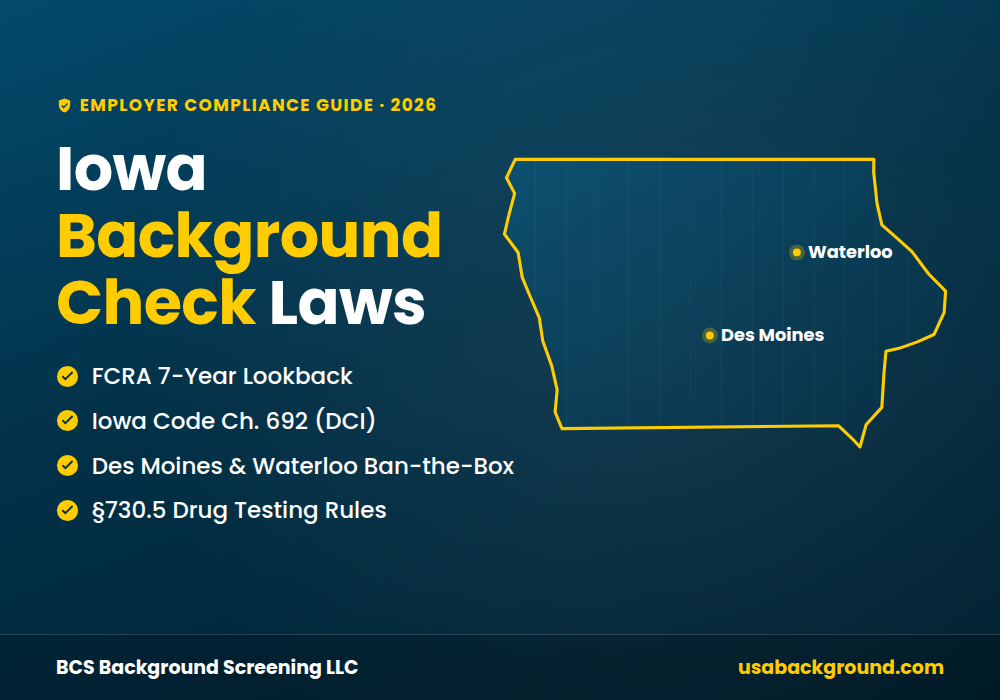
Iowa Background Check Laws at a Glance
Iowa has no single background check statute. Instead, several laws each cover one piece of the hiring process. The table below lists every key rule, its citation, and the agency in charge.
| Topic | Iowa Rule for Employers | Statute or Regulation | Administering Agency |
|---|---|---|---|
| Consumer reports | No state mini-FCRA. The federal FCRA governs all third-party screening. | 15 U.S.C. §1681 et seq. | FTC and CFPB |
| State criminal history | DCI releases records on written request. Dispositionless arrests over 18 months old need a signed release. | Iowa Code §692.2 | Iowa DPS, Division of Criminal Investigation |
| Ban the box | No statewide private-employer law. Des Moines and Waterloo delay criminal history questions. | Iowa Code §364.3(12); Des Moines Code §62-71.1; Waterloo Ord. 5522 | Des Moines and Waterloo human rights commissions |
| Lookback period | No state cap. FCRA limits non-conviction records to seven years. | 15 U.S.C. §1681c | FTC and CFPB |
| Expungement | Dismissals, deferred judgments, and one misdemeanor may become confidential. | Iowa Code §§901C.2, 901C.3, 907.9 | Iowa Judicial Branch (district courts) |
| Credit checks | No Iowa restriction. Standard FCRA consent and notice rules apply. | 15 U.S.C. §1681b | FTC and CFPB |
| Driving records | Personal information requires written consent or a federal DPPA exception. | Iowa Code §321.11; 18 U.S.C. §2721 | Iowa Department of Transportation |
| Drug testing | Written policy, certified lab, confirmation test, and MRO review required. | Iowa Code §730.5 | Iowa district courts (private lawsuits) |
| Polygraph | Employers may not require lie detector tests, except in law enforcement. | Iowa Code §730.4 | Iowa Attorney General and county attorneys |
| Negligent hiring | No negligent hiring claim may rest solely on a worker’s conviction. | Iowa Code §671A.1 | Iowa courts |
| Discrimination | The Iowa Civil Rights Act covers employers with four or more employees. | Iowa Code ch. 216 | Iowa Office of Civil Rights |
Does Iowa Have Its Own FCRA?
No. Iowa has not passed a state version of the Fair Credit Reporting Act. Instead, the federal Fair Credit Reporting Act governs every employment background check in Iowa. The Federal Trade Commission and the Consumer Financial Protection Bureau enforce it.
Iowa’s newer privacy statute leaves that framework intact. The Iowa Consumer Data Protection Act, Iowa Code chapter 715D, took effect January 1, 2025. However, Iowa Code §715D.2 exempts applicant and employee data. It also exempts FCRA-regulated consumer reporting activity. The Iowa Attorney General enforces chapter 715D.
Four FCRA Steps Every Iowa Employer Must Follow
- 1
Disclose and Authorize
Give a clear, standalone written disclosure. Next, obtain written authorization under 15 U.S.C. §1681b(b)(2).
- 2
Certify Compliance
Certify your permissible purpose to BCS Background Screening LLC before you order any report.
- 3
Pre-Adverse Action
Send the applicant a copy of the report and the CFPB Summary of Rights. Wait before you decide.
- 4
Adverse Action
Send a final notice with the agency’s contact details and dispute rights. State that the agency did not decide.
Need templates? Download disclosure and adverse action samples from our compliance forms library.
Iowa Criminal Background Checks Under Iowa Code Chapter 692
Iowa Code chapter 692 controls how the state shares criminal history data. The Iowa Division of Criminal Investigation (DCI) administers it within the Iowa Department of Public Safety. Under Iowa Code §692.2, private employers may request DCI records by written application.
Several limits apply. First, arrests lacking a disposition after 18 months have limited release. Only justice agencies, the subject, or a requester with a signed release may receive them. Second, the DCI charges $15 per last name searched. Third, employers must pay that fee when they require an applicant’s own certified record.
Why Court Searches Matter in Iowa
DCI data depends on fingerprint-supported arrests and court reporting, so gaps can occur. For that reason, many employers pair DCI results with court record searches. The Iowa Judicial Branch posts district court case data through Iowa Courts Online.
BCS Background Screening LLC offers a real-time Iowa statewide criminal search covering all 99 counties. Most results return within 24 hours.
Criminal Record Lookback Limits in Iowa
Iowa has no state law capping how far back a criminal background check may reach. Instead, FCRA Section 605, codified at 15 U.S.C. §1681c, sets the limits for screening companies. The FTC and CFPB enforce these time frames.
- 7 Years
Arrests, civil suits, and judgments older than seven years generally drop off. §1681c(a)(2)
- No Limit
Criminal convictions may be reported regardless of age. §1681c(a)(5)
- $75,000+
Seven-year limits do not apply to jobs paying $75,000 or more a year. §1681c(b)(3)
- 18 Months
DCI withholds dispositionless arrests after 18 months unless you hold a signed release. Iowa Code §692.2
Iowa Ban-the-Box Laws: Des Moines and Waterloo
Iowa has no statewide ban-the-box law for private employers. Moreover, Iowa Code §364.3(12) bars cities from adopting hiring rules that exceed state or federal law. That preemption statute shapes every local fair-chance ordinance in Iowa.
Waterloo Fair Chance Ordinance
Waterloo adopted Ordinance 5522 to limit criminal history questions. Business groups then sued under §364.3(12). On June 18, 2021, the Iowa Supreme Court decided Iowa Ass’n of Business & Industry v. City of Waterloo.
The court struck the rules limiting how employers use criminal history. However, it kept the timing rules, as Jackson Lewis P.C. explains. Waterloo employers still cannot ask about records on job applications. Employers with 15 or more employees must also wait until after a conditional offer. The Waterloo Commission on Human Rights handles local complaints.
Des Moines Criminal Record Inquiry Ordinance
Des Moines passed Ordinance No. 16,083 on November 15, 2021. It added Section 62-71.1 to the city’s human rights code. The rule covers employers with four or more employees.
Covered employers cannot place criminal record questions on applications. Interviewers also cannot ask about convictions, arrests, or pending charges before a conditional offer. Inquiries required by federal or state law remain allowed. Similarly, you may discuss a record the applicant raises voluntarily. Ogletree Deakins notes that state agencies and private K-12 schools fall outside the rule. The Des Moines Civil and Human Rights Commission enforces it.
Expunged and Deferred Judgment Records in Iowa
Iowa Code chapter 901C lets courts remove certain criminal records from public view. Iowa district courts, part of the Iowa Judicial Branch, grant these orders. Once expunged, a record becomes confidential. Consequently, it should not appear on an employment background check.
- Dismissals and acquittals: Iowa Code §901C.2 allows expungement 180 days after the case ends, once court costs are paid.
- One misdemeanor: Iowa Code §901C.3 permits one lifetime expungement eight years after conviction. Many offenses stay ineligible, including OWI, assault, and sex offenses.
- Deferred judgments: Iowa Code §907.9(4)(b) expunges the court record after probation discharge and full payment.
Iowa Legal Aid explains these options for applicants. For employers, the lesson is simple. Always rely on current court data rather than old copies of records.
Credit Checks and Driving Records in Iowa
Employment Credit Reports
Iowa does not restrict employment credit checks. Therefore, the federal FCRA disclosure, authorization, and adverse action rules control. Still, credit history can raise disparate impact concerns under Title VII. Limit credit checks to finance, cash-handling, or security roles.
Iowa Driving Records
Iowa Code §321.11 governs motor vehicle records held by the Iowa Department of Transportation. It follows the federal Driver’s Privacy Protection Act. Accordingly, personal information requires written consent or a federal exception.
Motor carriers face added duties. Under 49 CFR 391.23, carriers must pull three years of driving records within 30 days of hire. Our Motor Vehicle Records search delivers that history fast.
Iowa Drug Testing and Polygraph Laws
Iowa Code §730.5 sets detailed private-sector drug testing rules. It covers private employers with at least one full-time employee. Employees and applicants enforce it through lawsuits in Iowa district court.
- Adopt a written policy, and give it to everyone subject to testing.
- Use a SAMHSA-certified laboratory, then confirm positives with a different method.
- Route positive results through a medical review officer before they reach you.
- Split every sample so employees can request a retest within seven days.
- Send written notice of a confirmed positive by certified mail, return receipt requested. Since June 6, 2025, you may instead deliver it in person or electronically if the employee chooses.
Employers may test applicants, too. However, the law allows hair testing for applicants only. Violations can bring reinstatement, back pay, and attorney fee awards.
Meanwhile, Iowa has no marijuana or medical cannabidiol employment protection. In addition, §730.5 immunizes employers that act on a confirmed positive caused by medical cannabidiol use under chapter 124E.
Iowa Polygraph Ban
Iowa Code §730.4 bars employers from requiring lie detector tests. Law enforcement and corrections agencies hold a narrow exception. Violations count as simple misdemeanors with a minimum $250 fine. Additionally, the attorney general or a county attorney may seek an injunction.
Fair Hiring and Individualized Assessments in Iowa
The Iowa negligent hiring shield encourages second-chance hiring. Even so, it does not replace careful review. The EEOC recommends weighing the offense, the time elapsed, and the job duties. That individualized review also reduces Title VII risk.
Meanwhile, the Iowa Civil Rights Act, Iowa Code §216.6, covers employers with four or more employees. The Iowa Office of Civil Rights investigates those complaints. Apply your screening criteria the same way to every applicant.
Iowa Industry-Specific Background Check Requirements
Some Iowa jobs require checks beyond standard employment screening. These statutes add fingerprints, abuse registries, or licensing reviews.
Health Care & Home Care
Covered facilities and home care providers check DCI records and child and dependent adult abuse registries. Read §135C.33.
Child Care Providers
Licensed and registered providers need state, abuse registry, sex offender, and FBI fingerprint checks. Read §237A.5.
Licensed Professions
Boards may deny licenses only for convictions that directly relate to the profession. Read §272C.15.
Trucking & CDL Drivers
Motor carriers must obtain three years of driving records for each new driver within 30 days.
Iowa Employment Screening Services
BCS Background Screening LLC helps Iowa employers screen quickly and compliantly. Pick single searches, or bundle them into a package.
Iowa Statewide Criminal Search
Real-time search of Iowa court records across all 99 counties.
County Criminal Court Search
Researcher-verified courthouse searches with a seven-year standard scope.
Federal Criminal Search
Find federal cases that state and county searches miss.
Nationwide Background Check
SSN trace, multi-state criminal database, sex offender registry, and watchlists.
Motor Vehicle Records
Driving histories for delivery, trucking, sales, and CDL positions.
Self-Screen Mobile Screening
Applicants e-sign FCRA disclosures and enter their own data from any phone.
Every user account includes optional Multiple Authentication Factor (MAF) for added login security.
Iowa Employer Background Check Compliance Checklist
Use this checklist before you screen your next Iowa applicant.
- Remove criminal history questions from applications used in Des Moines or Waterloo.
- Run criminal checks only after a conditional offer in those cities.
- Provide a standalone FCRA disclosure, and collect written authorization.
- Pay DCI fees whenever you require an applicant’s own certified record.
- Get written consent before ordering Iowa driving records.
- Put your drug testing policy in writing before any test.
- Send pre-adverse and adverse action notices on time.
- Review each record individually using the EEOC factors.
Iowa Background Check Laws: 7 Employer FAQs
Does Iowa have a state version of the Fair Credit Reporting Act?
No. Iowa has no mini-FCRA, so the federal Fair Credit Reporting Act, 15 U.S.C. §1681 et seq., governs employment screening. It requires disclosure, written authorization, and adverse action notices. The Federal Trade Commission and the Consumer Financial Protection Bureau enforce it. Iowa’s Consumer Data Protection Act, Iowa Code chapter 715D, exempts employment data and FCRA-regulated activity.
How far back can an employment background check go in Iowa?
Iowa sets no state lookback limit. Instead, FCRA Section 605, 15 U.S.C. §1681c, generally bars reporting arrests and other non-conviction records older than seven years. Convictions have no time limit. The seven-year rule also disappears for jobs paying $75,000 or more. Separately, Iowa Code §692.2 lets the DCI release dispositionless arrests older than 18 months only with a signed release.
Does Iowa have a ban-the-box law?
Not statewide. Iowa Code §364.3(12) bars cities from adopting hiring rules stricter than state or federal law. Still, two city ordinances delay criminal history questions. Des Moines Code Section 62-71.1 covers employers with four or more employees until a conditional offer. Waterloo Ordinance 5522 bans application questions and delays inquiries for employers with 15 or more employees. Local human rights commissions enforce both.
Can Iowa employers see expunged or deferred judgment records?
Generally, no. Iowa Code §901C.2 allows expungement of dismissed and acquitted cases after 180 days. Section 901C.3 allows one misdemeanor expungement eight years after conviction. Section 907.9 expunges deferred judgment court records after probation discharge. Iowa district courts grant these orders, and expunged records become confidential. Therefore, compliant background checks should not report them.
How do Iowa employers get a state criminal history record check?
Employers submit a written request to the Iowa Division of Criminal Investigation. The DCI, part of the Iowa Department of Public Safety, administers Iowa Code chapter 692. It charges $15 per last name searched. Under Iowa Code §692.2(6)(b), employers must pay that fee when requiring an applicant’s own certified record. Many employers also add a statewide court search for faster, fuller results.
Can Iowa employers check an applicant’s driving record?
Yes, with proper consent. Iowa Code §321.11 protects personal information in Iowa Department of Transportation records. It follows the federal Driver’s Privacy Protection Act, 18 U.S.C. §2721. Employers need the driver’s written consent or a permitted federal purpose. Motor carriers must also obtain three years of driving records under 49 CFR 391.23.
What rules apply when Iowa employers drug test applicants?
Iowa Code §730.5 controls private-sector drug testing. Employers need a written policy, a federally certified laboratory, confirmation testing, and medical review officer review. Samples must be split so employees can request a retest. Hair testing is allowed only for applicants. Iowa district courts enforce the law and may award reinstatement, back pay, and attorney fees.
Screen Iowa Applicants with Confidence
Open a free business account in minutes. Then order Iowa statewide, county, federal, and driving record searches from one dashboard.
Legal disclaimer: This page offers general information about Iowa background check laws, not legal advice. Laws and ordinances change often. Consult qualified Iowa employment counsel about your specific situation. Last reviewed October 1, 2026. See all background screening laws by state.