
Colorado Background Check Laws for Employers: 2026 Compliance Guide
Colorado background check laws are among the strictest in the West. Its seven-year conviction limit, ban-the-box rule, and credit check ban all affect hiring.
This guide explains the statutes, lookback limits, and state agencies Colorado employers need to know before screening applicants.
- FCRA and Colorado-compliant screening
- Real-time Colorado statewide criminal search
- No setup or monthly fees for card customers
Colorado Background Check Laws at a Glance
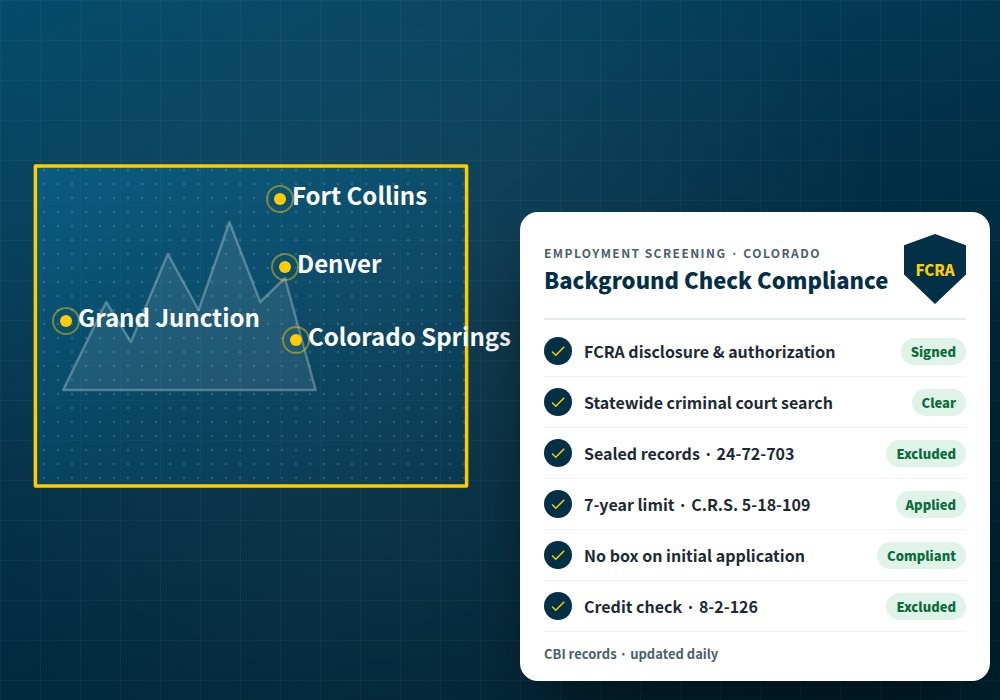
First, scan this table to see which rules apply to your hiring. Then, read the detailed sections below.
| Topic | Colorado rule | Law | Administered by |
|---|---|---|---|
| State FCRA equivalent | Yes. The Colorado Consumer Credit Reporting Act regulates screening reports. | C.R.S. § 5-18-101 et seq. | Colorado Attorney General; civil lawsuits |
| Criminal record lookback | Seven years from disposition, release, or parole. No salary exception since August 10, 2022. | C.R.S. § 5-18-109 | Colorado Attorney General; civil lawsuits |
| Non-conviction records | Screeners may never report sealed, expunged, or non-conviction records. | C.R.S. § 5-18-109 | Colorado Attorney General; civil lawsuits |
| Ban the box | No criminal history questions on initial applications. Covers all private employers. | C.R.S. § 8-2-130 | CDLE Division of Labor Standards and Statistics |
| Public employers | Agencies generally wait until finalist stage or a conditional offer. | C.R.S. § 24-5-101 | State and local agencies |
| Clean Slate sealing | Eligible records seal automatically after 4, 7, or 10 years. | C.R.S. §§ 24-72-705, 24-72-706 | Colorado courts; CBI |
| Sealed record inquiries | Employers may not require applicants to disclose sealed records. | C.R.S. § 24-72-703 | Colorado courts |
| Credit checks | Banned unless substantially related to the job or legally required. | C.R.S. § 8-2-126 | CDLE Division of Labor Standards and Statistics |
| Age on applications | No date of birth or graduation dates on initial applications. | C.R.S. § 8-2-131 | CDLE Division of Labor Standards and Statistics |
| Pay transparency | Job postings must list compensation and benefits. | C.R.S. § 8-5-201 et seq. | CDLE Division of Labor Standards and Statistics |
| Salary history | You may not seek an applicant’s wage rate history or rely on it to set pay. | C.R.S. § 8-5-102 | CDLE Division of Labor Standards and Statistics |
| Social media | You cannot demand login credentials or privacy changes. | C.R.S. § 8-2-127 | CDLE Division of Labor Standards and Statistics |
| Marijuana | Off-duty marijuana use is not protected lawful activity. | C.R.S. § 24-34-402.5; Coats v. Dish Network | Colorado courts |
| Driving records | Seven-year and full history records require consent or a DPPA purpose. | C.R.S. § 24-72-204(7); 18 U.S.C. § 2721 | Colorado DMV, Department of Revenue |
| AI in hiring | Notice, explanation, and human review duties begin January 1, 2027. | SB 26-189 | Colorado Attorney General |
| Data breach | Notify residents within 30 days. Tell the AG if 500 or more are affected. | C.R.S. § 6-1-716 | Colorado Attorney General |
Does Colorado Have Its Own FCRA?
Yes. The Colorado Consumer Credit Reporting Act, C.R.S. § 5-18-101 et seq., works alongside the federal Fair Credit Reporting Act.
The state law adds tighter reporting limits for employment screening. As a result, a compliant Colorado report often shows less history than reports in other states.
Meanwhile, federal duties still apply to every hire. The FTC guide for employers spells out each step. You can also read the full FCRA text.
The Four FCRA Steps for Every Colorado Hire
- 1
Disclose
Give a clear, standalone written disclosure before you order the report.
- 2
Authorize
Get written permission. Our mobile e-signature platform captures it securely.
- 3
Pre-adverse action
Send the report and the FCRA Summary of Rights before you decide.
- 4
Adverse action
After a final decision, send the adverse action notice with dispute rights.
How Far Back Do Background Checks Go in Colorado?
Colorado sets a firm seven-year limit. Under C.R.S. § 5-18-109, screeners cannot report arrest, indictment, or conviction records older than seven years.
The clock runs from disposition, release, or parole. Moreover, the law bars sealed, expunged, and non-conviction records at any age.
SB 22-099 (effective August 10, 2022) repealed the $75,000 employment exception from C.R.S. § 5-18-109(2), and HB 23-1126 (August 7, 2023) left the subsection with a single exception for credit transactions above the national conforming loan limit. SB 22-099 also added § 5-18-109(1)(e.5), which bars a consumer reporting agency from reporting sealed records, expunged records, and records that did not result in a conviction at any age.
Since August 10, 2022, Colorado also bars screening companies from reporting sealed records, expunged records, and arrests or charges that did not result in a conviction, at any age and at any salary (C.R.S. § 5-18-109(1)(e.5)).
The federal FCRA’s $75,000 exception does not revive them: the state rule is stricter and governs in Colorado.
Federal law differs here. Under 15 U.S.C. § 1681c, convictions carry no time limit. Colorado reports therefore follow the stricter state rule.
Even so, recent convictions still deserve careful review. The EEOC arrest and conviction guidance asks you to weigh the offense, time elapsed, and job duties.
- 7 years
Criminal records
Arrests, indictments, and convictions older than seven years stay off Colorado reports.
- Never reported
Sealed and non-conviction
Sealed, expunged, and non-conviction records cannot appear, no matter how recent.
- 4·7·10 years
Automatic sealing
Clean Slate seals eligible infractions, misdemeanors, and felonies after these waiting periods.
Colorado Ban the Box: The Chance to Compete Act
Colorado bans the box for private employers. The Chance to Compete Act, C.R.S. § 8-2-130, has covered every private employer since September 1, 2021.
You cannot ask about criminal history on an initial application. Also, your job ads cannot say that people with records may not apply.
After the initial application, you may run a background check. The CDLE Chance to Compete FAQ explains the timing.
Exceptions apply when law bars certain records for the job or requires a check. Public employers follow a separate rule in C.R.S. § 24-5-101.
Colorado Clean Slate Act and Sealed Records
Colorado seals many old records automatically. The Clean Slate Act and HB 24-1133 took full effect on July 1, 2025.
Eligible civil infractions seal after four years. Misdemeanors seal after seven years, and eligible felonies after ten.
The Colorado Lawyer explains the process. Courts enter the orders, and CBI then seals its records.
What Sealing Means for Employers
Under C.R.S. § 24-72-703, employers may not require applicants to disclose sealed records. Applicants may state they have no conviction.
However, checks that a statute or rule requires can still reach sealed records. Teacher licensing is one example.
Credit Checks, Age Questions, and Pay Rules in Colorado
Credit Check Restrictions
The Employment Opportunity Act, C.R.S. § 8-2-126, bans most credit checks. The CDLE INFO #9D lists the exceptions.
Banks, financial institutions, and certain management roles qualify. When you require a credit report, disclose your bona fide, job-related purpose in writing. If credit data drives a denial, disclose it in writing.
Age and Date of Birth
The Job Application Fairness Act, C.R.S. § 8-2-131, took effect July 1, 2024. It bars birth dates and graduation dates on initial applications.
Consequently, collect date of birth for background checks only after the initial application. Ogletree’s alert covers the details.
Postings and Social Media
The Equal Pay for Equal Work Act requires pay and benefits in job postings. The CDLE hiring laws page summarizes each rule.
The same Act also bans salary history questions. Under C.R.S. § 8-5-102, you may not seek an applicant’s wage rate history or rely on it to set pay. The ban has covered all employers since January 1, 2021.
In addition, C.R.S. § 8-2-127 bars demands for social media passwords.
Driving Records, Drug Testing, and AI Screening in Colorado
The Colorado DMV offers seven-year and full history driving records. You need the driver’s written consent or a DPPA-permitted purpose.
For CDL drivers, 49 C.F.R. § 391.23 also requires a three-year record within 30 days of hire.
Marijuana and Drug Testing
Recreational marijuana is legal in Colorado. Still, off-duty use is not protected. In Coats v. Dish Network, the Colorado Supreme Court upheld a firing after a positive test.
AI Hiring Tools
Colorado replaced its 2024 AI Act with SB 26-189. According to Seyfarth Shaw, new notice and human review duties start January 1, 2027.
E-Verify and Work Authorization
Colorado has no E-Verify mandate for private employers. However, contractors on public contracts for services face a separate rule. Under C.R.S. § 8-17.5-102, they must confirm the work eligibility of employees newly hired for the contract.
They use E-Verify or the state Department Program. They may not use either program for pre-employment screening. Meanwhile, federal Form I-9 duties still apply to every new hire.
Industry-Specific Background Check Requirements in Colorado
Several Colorado laws require fingerprint checks for jobs that involve children, patients, or public trust.
Child Care Providers
Staff need CBI and FBI fingerprints plus a TRAILS abuse registry check. The Department of Early Childhood manages the process.
Educators
License applicants submit fingerprints for a national check. The Colorado Department of Education reviews results from CBI.
Licensed Professions
Health care workers, law enforcement, and many licensees need fingerprint checks under specific statutes.
Public Employers
State and local agencies cannot rely on arrests without convictions. Most wait until the finalist stage to check records.
Financial Roles
Banks and financial institutions may still use credit reports. Other employers need a job-related reason.
Automated Hiring Tools
Employers using AI in hiring must give notice, explain adverse outcomes, and offer human review from 2027.
Off-Duty Conduct
You generally cannot fire workers for lawful off-duty activity. Marijuana use does not qualify under Coats.
Applicant Data Security
Notify affected residents within 30 days of a breach. Also notify the Attorney General when a breach reaches 500 or more residents.
Screen Colorado Applicants the Compliant Way
BCS Background Screening LLC helps Colorado employers hire with confidence. We build every search around FCRA rules and Colorado’s seven-year limit.
Colorado Real-Time Statewide Search
Real-time search of CBI felony and misdemeanor records, updated daily.
County Criminal Court Searches
Direct searches of Denver, El Paso, Arapahoe, and other Colorado county courts.
Federal Criminal Searches
U.S. District Court for the District of Colorado records that state searches miss.
Nationwide Background Check
SSN trace, national criminal database, sex offender registry, and government watchlists.
Motor Vehicle Records
Driving histories for delivery, trucking, sales, and CDL positions.
Mobile E-Signature Screening
Applicants e-sign FCRA disclosures and enter their own data after the initial application.
Colorado Background Check Compliance Checklist
Before you screen your next Colorado applicant, confirm each item below.
- Remove criminal history questions from your initial application and job ads.
- Remove date of birth and graduation dates from the initial application.
- Use a standalone FCRA disclosure and collect written authorization.
- Confirm reports follow Colorado’s seven-year criminal record limit.
- Never require applicants to disclose sealed records.
- Skip credit checks unless an Employment Opportunity Act exception applies.
- Get written consent before you request a Colorado driving record.
- Review each conviction against the offense, time elapsed, and job duties.
- Send pre-adverse and adverse action notices, in that order.
- Compare rules for other states in our screening laws by state hub.
Colorado Employment Screening Laws: FAQs
These answers name the governing statute, explain what it does, and identify the agency in charge.
Does Colorado have a state version of the Fair Credit Reporting Act?
Yes. The Colorado Consumer Credit Reporting Act, C.R.S. § 5-18-101 et seq., regulates consumer reports, including employment background checks.
It adds stricter reporting limits than the federal FCRA. The Colorado Attorney General enforces it, and consumers may also sue.
How far back can a Colorado criminal background check go?
Seven years. Under C.R.S. § 5-18-109, screeners cannot report criminal records older than seven years from disposition, release, or parole.
Sealed, expunged, and non-conviction records cannot appear at all. Unlike federal law, Colorado offers no $75,000 salary exception.
Is Colorado a ban-the-box state?
Yes. The Chance to Compete Act, C.R.S. § 8-2-130, bars criminal history questions on initial applications for all private employers.
The CDLE Division of Labor Standards and Statistics enforces it. Fines reach $2,500 for repeat violations.
Can Colorado applicants deny sealed criminal records?
Yes. Under C.R.S. § 24-72-703, employers may not require disclosure of sealed records, and applicants may state they have no conviction.
The Clean Slate Act seals eligible records automatically after four, seven, or ten years. Colorado courts order sealing, and CBI updates its files.
Can Colorado employers run credit checks on applicants?
Usually not. The Employment Opportunity Act, C.R.S. § 8-2-126, bans credit checks unless they are substantially related to the job.
Banks, financial institutions, and certain management roles qualify. The CDLE Division of Labor Standards and Statistics enforces the law.
When can Colorado employers ask for date of birth for a background check?
After the initial application. The Job Application Fairness Act, C.R.S. § 8-2-131, bars age, birth date, and graduation date questions at that stage.
The CDLE Division of Labor Standards and Statistics enforces it. Later, you may collect date of birth to run the check.
Can Colorado employers drug test for marijuana?
Yes. The lawful off-duty activities statute, C.R.S. § 24-34-402.5, does not protect marijuana use because federal law still bans it.
The Colorado Supreme Court confirmed this in Coats v. Dish Network in 2015. Colorado courts decide claims under the statute.
Start Screening Colorado Applicants Today
Open your free account with BCS Background Screening LLC in minutes. Then, pay only for the searches you order.
All user accounts offer optional Multiple Authentication Factor (MAF) security.
This page offers general information, not legal advice. Laws change, so consult Colorado employment counsel before you act. Last reviewed October 2026.