
California Background Check Laws for Employers: 2026 Compliance Guide
California background check laws are the strictest in the nation. Two state FCRAs, the Fair Chance Act, and local ordinances all shape every hire.
This guide explains the statutes, lookback limits, and agencies California employers need to know before screening applicants.
- FCRA, ICRAA, and Fair Chance Act compliant
- Real-time California statewide criminal search
- No setup or monthly fees for card customers
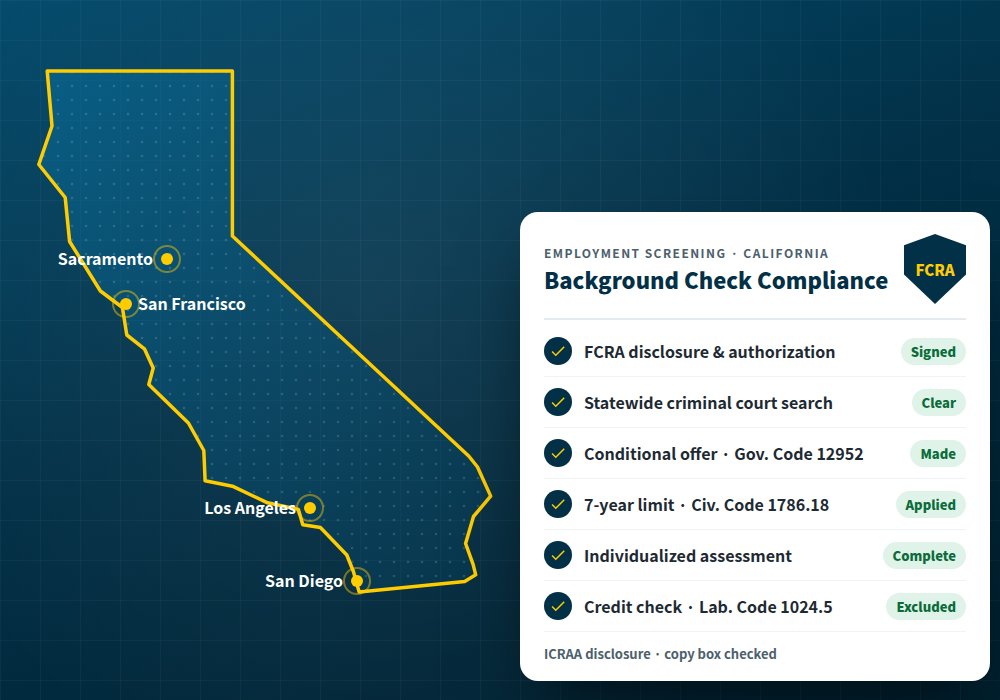
California Background Check Laws at a Glance
First, scan this table to see which rules apply to your hiring. Then, read the detailed sections below.
| Topic | California rule | Law | Administered by |
|---|---|---|---|
| Background check reports | Separate disclosure, written consent, and a box to request a report copy. | Cal. Civ. Code § 1786 et seq. (ICRAA) | Enforced through civil lawsuits |
| Credit reports | Written notice before use, plus state reporting duties for credit bureaus. | Cal. Civ. Code § 1785 et seq. (CCRAA) | Enforced through civil lawsuits |
| Criminal record lookback | Seven years from disposition, release, or parole. No salary exception. | Cal. Civ. Code § 1786.18 | Enforced through civil lawsuits |
| Ban the box | No conviction questions before a conditional offer. Employers with 5+ employees. | Cal. Gov. Code § 12952 | Civil Rights Department |
| Individualized assessment | Preliminary notice, five business days to respond, then final notice. | Cal. Gov. Code § 12952; 2 CCR § 11017.1 | Civil Rights Department |
| Protected records | No arrests without conviction, diversion, or sealed and dismissed convictions. | Cal. Lab. Code § 432.7 | Enforced through civil lawsuits |
| Automatic record relief | DOJ grants relief for eligible arrests and convictions each month. | Cal. Penal Code §§ 851.93, 1203.425 | California Department of Justice |
| Credit checks | Allowed only for listed positions, such as managers and cash handlers. | Cal. Lab. Code § 1024.5 | California Labor Commissioner |
| Cannabis | No penalty for off-duty use or non-psychoactive metabolite tests. | Cal. Gov. Code § 12954 | Civil Rights Department |
| Salary history | Employers may not seek an applicant’s prior pay. Employers with 15+ employees must post pay scales. | Cal. Lab. Code § 432.3 | California Labor Commissioner |
| Driver’s license rules | Postings may not require a license unless driving is a job function. | Cal. Gov. Code § 12940 | Civil Rights Department |
| Commercial drivers | Pull a current DMV record and join the Employer Pull Notice program. | Cal. Veh. Code § 1808.1 | California DMV |
| E-Verify timing | Do not run applicants through E-Verify before a job offer. | Cal. Lab. Code § 2814 | California Labor Commissioner |
| AI hiring tools | Automated systems may not screen criminal history before an offer. | 2 CCR (FEHA ADS rules, Oct. 1, 2025) | Civil Rights Department |
| Local ordinances | Los Angeles City, LA County, and San Francisco add stricter steps. | LAMC 189; LA County Code 8.300; SF Police Code Art. 49 | BCA; DCBA; OLSE |
California’s Two State FCRAs: ICRAA and CCRAA
California has two state versions of the Fair Credit Reporting Act. Both apply on top of federal law.
The Investigative Consumer Reporting Agencies Act (ICRAA), Cal. Civ. Code § 1786 et seq., covers most background checks. Meanwhile, the Consumer Credit Reporting Agencies Act (CCRAA) covers credit reports.
ICRAA requires a standalone disclosure and written authorization. Under Cal. Civ. Code § 1786.16, the form must include a box to request a copy. You must then send that copy within three business days.
In addition, Civ. Code § 1786.53 covers public records you obtain without a screening company. You must give the applicant a copy within seven days.
Federal duties still apply, too. The FTC guide for employers covers the FCRA steps.
The Four Screening Steps for Every California Hire
- 1
Conditional offer
Make a conditional job offer before you ask about or check conviction history.
- 2
Disclose and authorize
Give the FCRA and ICRAA disclosures. Our mobile e-signature platform captures consent.
- 3
Assess and notify
Complete an individualized assessment. Then, send a preliminary notice with the report.
- 4
Wait, then decide
Allow at least five business days to respond. Afterward, send a final written notice.
How Far Back Do Background Checks Go in California?
California sets a strict seven-year limit. Under Cal. Civ. Code § 1786.18, screeners cannot report arrest or conviction records older than seven years.
The clock runs from disposition, release, or parole. Moreover, a record drops off after a full pardon or when no conviction results.
Unlike the federal FCRA, ICRAA has no $75,000 salary exception. It exempts only life insurance underwriting and employers a regulator explicitly requires to check older records.
Federal law differs. Under 15 U.S.C. § 1681c, convictions carry no time limit. California reports therefore follow the stricter state rule.
Local laws can go further. San Francisco, for example, bars most employers from considering convictions older than seven years.
Even so, recent convictions still require a fair review. The EEOC arrest and conviction guidance uses similar factors.
- 7 years
Criminal records
Arrests and convictions older than seven years stay off California investigative reports.
- 5 business days
Applicant response time
Applicants get at least five business days to answer a preliminary notice.
- 4 years
Felony record relief
DOJ grants automatic relief for many felonies four years after supervision ends.
California Fair Chance Act: Ban the Box Rules
California bans the box for employers with five or more employees. The Fair Chance Act, Cal. Gov. Code § 12952, took effect in 2018.
You cannot ask about conviction history before a conditional offer. Also, you cannot consider arrests without conviction or sealed and dismissed records.
Before withdrawing an offer, complete an individualized assessment. Consider the offense, the time since it happened, and the job duties.
Next, send a preliminary notice with the report. The applicant then gets at least five business days to respond. Finally, send a written final decision. In addition, you still owe the FCRA pre-adverse and adverse action notices.
The regulations in 2 CCR § 11017.1 add detail, and the Civil Rights Department enforces them.
Local Fair Chance Ordinances in California
Several California cities and counties add rules on top of the Fair Chance Act. Always check where the employee will work.
City of Los Angeles
The Fair Chance Initiative for Hiring Ordinance covers employers with ten or more employees. It bars criminal history questions on applications and postings.
Employers must also use an assessment and reassessment process. The Bureau of Contract Administration enforces it.
Los Angeles County
Since September 3, 2024, the county ordinance covers unincorporated areas. It applies to employers with five or more employees.
It adds posting and notice duties. It also bars considering convictions older than seven years for most positions. The Department of Consumer and Business Affairs enforces it.
San Francisco
The Fair Chance Ordinance bars most convictions older than seven years and infractions.
Amendments took effect August 10, 2026. According to Littler, they expand protected convictions and response duties. OLSE enforces the ordinance.
Records California Employers Cannot Ask About or Use
California protects several kinds of records. Under Cal. Lab. Code § 432.7, you cannot ask about or use arrests that did not lead to conviction.
The same rule covers diversion programs and convictions that a court dismissed or sealed. It also covers juvenile court information. In addition, Labor Code § 432.8 protects many marijuana convictions older than two years.
California also has a social media password law, Cal. Lab. Code § 980. Therefore, do not ask applicants for their social media passwords.
Automatic Record Relief
California also clears many records automatically. The Department of Justice reviews its databases monthly under Penal Code §§ 851.93 and 1203.425.
Relief does not delete the record. However, DOJ limits who can see it, and courts restrict public access.
Credit Checks, Driving Records, Cannabis, and AI in California
Credit Check Limits
Under Cal. Lab. Code § 1024.5, employers may use credit reports only for listed roles. Managers, law enforcement, and signers on company accounts qualify.
So do jobs with regular access to $10,000 or more in cash. Also, Labor Code § 432.3 bars salary history questions. San Francisco’s Parity in Pay Ordinance adds a local ban.
In addition, § 432.3 requires a pay scale on reasonable request. Employers with 15 or more employees must also include it in job postings. Since January 1, 2026, that means a good-faith estimate of the range you expect to pay upon hire.
Driving Records (MVRs)
Employers of commercial drivers must pull a DMV record under Vehicle Code § 1808.1. They must also join the DMV Employer Pull Notice program.
Meanwhile, Gov. Code § 12940 bars requiring a driver’s license in postings unless driving is a job function.
Cannabis and AI Tools
Under Gov. Code § 12954, you cannot penalize off-duty cannabis use. You also cannot ask about prior use.
AI rules took effect October 1, 2025. Paul Hastings explains that automated tools cannot screen criminal history before an offer.
In addition, the CPPA automated decisionmaking technology regulations, 11 CCR § 7001 et seq., took effect January 1, 2026. They add pre-use notice, opt-out, and access duties for covered businesses that use the technology for hiring decisions. Covered businesses must comply by January 1, 2027.
Industry-Specific Background Check Requirements in California
Several California laws require fingerprint checks for jobs that involve children, patients, or public trust.
Fingerprint Checks
Only agencies authorized by statute can request state fingerprint checks. The DOJ fingerprint program processes them.
Child and Community Care
Care facility staff need DOJ and FBI Live Scan checks. The Caregiver Background Check Bureau also checks the Child Abuse Central Index.
Commercial Drivers
Enroll covered drivers in the Employer Pull Notice program. The DMV then alerts you to convictions and suspensions.
E-Verify Timing
Do not use E-Verify on applicants before a job offer, unless federal law requires it. You must also give notice of tentative nonconfirmations.
Financial Roles
Credit checks remain available for managers, signers, and roles handling bank data or large cash amounts.
Record Relief Exceptions
Fingerprint checks for certain regulated jobs can still show relieved convictions, as the statute allows.
Automated Hiring Tools
Keep automated decision records for four years. Employers stay liable for bias created by vendor tools.
Drug Testing
Use tests that detect current impairment, not non-psychoactive metabolites. Some federal and construction roles are exempt.
Screen California Applicants the Compliant Way
BCS Background Screening LLC helps California employers hire with confidence. We build every search around ICRAA, the Fair Chance Act, and local rules.
California Real-Time Statewide Search
Real-Time search of 39 CA counties simultaneously, covering more than 96% of the state’s population. This is a private screening wholesaler, not a government agency.
County Criminal Court Searches
Direct searches of Los Angeles, San Diego, Orange, and California’s other 55 superior courts.
Federal Criminal Searches
Records from California’s four federal districts that state searches miss.
Nationwide Background Check
SSN trace, national criminal database, sex offender registry, and government watchlists.
Motor Vehicle Records
Driving histories for delivery, trucking, sales, and CDL positions.
Mobile E-Signature Screening
Applicants e-sign FCRA and ICRAA disclosures after a conditional offer, from any phone.
California Background Check Compliance Checklist
Before you screen your next California applicant, confirm each item below.
- Remove conviction and arrest questions from applications and job postings.
- Make a conditional offer before you run a criminal background check.
- Use California-specific ICRAA disclosure and authorization forms with a copy checkbox.
- Confirm reports follow the seven-year limit in Civil Code § 1786.18.
- Complete a written individualized assessment before any adverse action.
- Give at least five business days to respond to a preliminary notice.
- Check Los Angeles City, LA County, and San Francisco rules for local roles.
- Limit credit checks to positions listed in Labor Code § 1024.5.
- Update drug testing to exclude non-psychoactive cannabis metabolites.
- Compare rules for other states in our screening laws by state hub.
California Employment Screening Laws: FAQs
These answers name the governing statute, explain what it does, and identify the agency in charge.
Does California have a state version of the Fair Credit Reporting Act?
Yes, two. The Investigative Consumer Reporting Agencies Act, Cal. Civ. Code § 1786 et seq., covers most background checks.
The Consumer Credit Reporting Agencies Act, Cal. Civ. Code § 1785 et seq., covers credit reports. Applicants enforce both laws through civil lawsuits.
How far back can a California criminal background check go?
Seven years. Under Cal. Civ. Code § 1786.18, screeners cannot report older arrests or convictions. The clock runs from disposition, release, or parole.
There is no $75,000 salary exception. Only life insurance underwriting and regulator-required checks are exempt. Applicants enforce the limit through civil lawsuits.
Is California a ban-the-box state?
Yes. The Fair Chance Act, Cal. Gov. Code § 12952, covers employers with five or more employees. It bars conviction questions before a conditional offer.
It also requires an individualized assessment and five business days to respond. The California Civil Rights Department enforces the law.
Which criminal records can California employers not consider?
Cal. Lab. Code § 432.7 bars asking about arrests without conviction and diversion programs. It also protects dismissed and sealed convictions.
The Department of Justice also grants automatic relief under Penal Code §§ 851.93 and 1203.425. Applicants may sue over violations of section 432.7.
Can California employers run credit checks on applicants?
Only for listed positions. Cal. Lab. Code § 1024.5 allows credit reports for managers, law enforcement, and roles with major financial access.
That includes jobs with regular access to $10,000 or more in cash. The California Labor Commissioner enforces the law.
Do local fair chance ordinances apply in California?
Yes. Los Angeles City covers employers with ten or more employees, and the Bureau of Contract Administration enforces it.
Los Angeles County covers unincorporated areas through its Department of Consumer and Business Affairs. San Francisco’s Office of Labor Standards Enforcement enforces a seven-year limit.
Can California employers drug test for cannabis?
Only with limits. Cal. Gov. Code § 12954 bars penalizing off-duty cannabis use or tests that detect non-psychoactive metabolites.
Employers also cannot ask about prior cannabis use. The California Civil Rights Department enforces the law, and some federal roles are exempt.
Start Screening California Applicants Today
Open your free account with BCS Background Screening LLC in minutes. Then, pay only for the searches you order.
All user accounts offer optional Multiple Authentication Factor (MAF) security.
This page offers general information, not legal advice. Laws change, so consult California employment counsel before you act. Last reviewed October 2026.