
Massachusetts Statewide Criminal Background Check
Our Massachusetts statewide criminal background check reaches every court in the Commonwealth. Researchers work all 14 counties at once, in real time.
We skip the CORI repository entirely. Instead, our people search the courts themselves and confirm every record at the source.
What the Massachusetts Statewide Search Covers
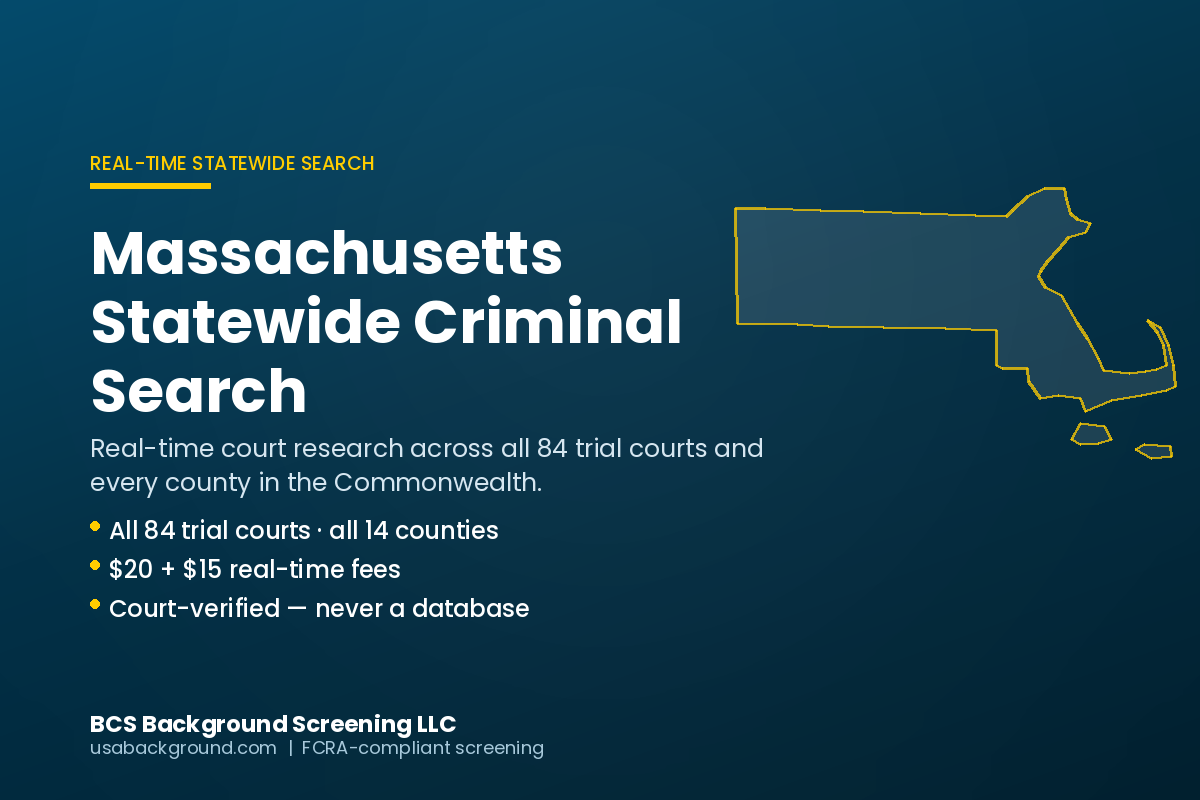
This search runs across every Massachusetts Superior Court and District Court. Altogether, that means 84 trial court locations in all 14 counties.
Massachusetts does not publish full criminal case detail online. Therefore, our researchers pull records from Public Access Terminals inside the courthouses themselves.
The Massachusetts Trial Court draws a clear line here. Some case data sits online, while the rest sits only at a courthouse public terminal.
Our model works on the courthouse side of that line.
Every Superior Court and District Court division, searched individually.
One order covers the whole Commonwealth. No county-by-county ordering.
Researchers search live court systems, never a stale private database.
We confirm every record at the court before it reaches your report.
Why Our Real-Time Supersearch Beats an iCORI Search
Most vendors resell the state CORI repository. We do not, and the difference shows up in your report.
| Massachusetts CORI / iCORI Repository | Our Real-Time Statewide Supersearch | |
|---|---|---|
| Access requirements | Requires CORI registration with DCJIS plus ongoing compliance with DCJIS policies. | No CORI registration, no CORI Acknowledgement Form, and no assigned access level. |
| Case detail | Case information often arrives incomplete and missing key reporting fields. | Full court-level case information, retrieved directly from the courthouse. |
| Non-convictions | Most employer CORI searches return only convictions and open cases. | Non-convictions included within 7 years, measured by file date. |
| Verification | Limited detail frequently forces a separate county court follow-up. | Court-level verification on every record found, so no follow-up order is needed. |
| Source | A central state repository that depends on agency reporting. | Live court records, read at the source by a researcher standing in the courthouse. |
| Fees | DCJIS charges a per-request CORI fee on top of vendor pricing. | $20 plus $15 in real-time fees, with nothing else added. |
Dropping the CORI paperwork does not drop your FCRA duties. You still need a standalone written disclosure and signed authorization before we search.
How the Real-Time Search Works
Four things happen after you submit a name. Consequently, you get court-grade detail instead of a database summary.
- Courthouse PAT searchResearchers work in person at Massachusetts courthouses. They query Public Access Terminals directly, court by court.
- Boots on the groundBecause our people stand in the building, they can ask clerks questions. Furthermore, they can pull the physical case file when detail is missing.
- Court-level confirmationWe verify identifiers against the court record before reporting anything. Name and date of birth must match.
- Fast returnClear searches average under 12 hours. Meanwhile, searches with records average under 72 hours.
Why in-person research still matters in Massachusetts
Many states publish full criminal dockets online. Massachusetts does not.
The Commonwealth restricts much of its criminal case detail to courthouse terminals. As a result, any vendor promising instant statewide Massachusetts results is quoting a database, not a court. Databases lag. Courts do not.
Scope and Lookback Periods
Massachusetts caps what a consumer reporting agency may report. Accordingly, our scope is built to stay inside those limits.
Felony and misdemeanor convictions report for ten years.
Dismissals, CWOFs, and pretrial probation report for seven years by file date.
Superior Court and District Court divisions statewide.
Most clear searches land the same business day.
Hits take longer because we verify each one at the court.
$20 search plus $15 real-time fees. No hidden repository charge.
Massachusetts also applies a seven-year reporting cap under M.G.L. c. 93, § 52. For the full picture, read our Massachusetts employment screening laws guide.
Court Coverage Across Massachusetts
One order reaches every county at once. Below are the 14 counties our researchers cover.
- Barnstable
- Berkshire
- Bristol
- Dukes
- Essex
- Franklin
- Hampden
- Hampshire
- Middlesex
- Nantucket
- Norfolk
- Plymouth
- Suffolk
- Worcester
Superior Court and District Court, both included
Superior Courts hear felonies and serious matters. District Courts handle misdemeanors and many felony cases. Plenty of vendors search one level only. We search both, so the report holds together.
Need a single county instead?
Sometimes you only want one jurisdiction. In that case, order a county-level search and specify Supersearch coverage. Otherwise, the statewide option costs less than stacking several county orders.
Massachusetts Statewide Criminal Search: Sample Report
Below is a complete sample report. Every name, date, docket number, and address is fictitious.
Case 1 — Chicopee District Court, filed 2022
Case 2 — Chicopee District Court, filed 2024
Case 3 — Hingham District Court, filed 2023
How to read this report
Notice that every entry carries a file date, a disposition date, and the full sentencing outcome. Court-level research produces that detail, while a database summary usually does not.
Notice too that all three cases ended without a conviction. A CORI repository search would probably have returned none of them.
M.G.L. c. 151B, § 4(9) bars a Massachusetts employer from asking about an arrest or a detention. The same bar covers any disposition that produced no conviction.
Dismissals, continuances without a finding, and pretrial probation all fall into that category. Therefore, you may not base a Massachusetts hiring decision on the three cases above.
Complete court data still protects you. It confirms identity, rules out mismatches, and shows exactly which entries you must set aside. Our Massachusetts employment screening laws guide walks through the rule in detail.
Massachusetts Criminal Records: Dispositions You Will See
Massachusetts uses disposition language that confuses employers from other states. Here is what the common entries mean.
Continued Without a Finding (CWOF)
The defendant admits facts sufficient for a finding of guilt. Then the court continues the case without entering a conviction. If probation ends cleanly, the charge is dismissed.
Pretrial Probation
The court diverts the case before any admission. The defendant completes a probation term, after which the charge is dismissed outright.
Dismissed – Request of Commonwealth
Here the prosecutor asks the court to drop the charge. No conviction results, and the court enters no finding against the defendant.
Guilty Filed
A guilty finding enters, yet the court imposes no sentence and files the case. Massachusetts treats this as a conviction.
24D Program
This is the statutory first-offender disposition for operating under the influence. It pairs a CWOF with a driver alcohol education program.
Sealed Record
A court has closed the case to public view under M.G.L. c. 276, § 100A. Sealed entries never appear on our report.
Read these labels carefully before you act. Only a conviction supports an adverse decision in Massachusetts.
A CWOF that ended in dismissal is not a conviction. Similarly, pretrial probation followed by dismissal is not a conviction.
How to Order the Massachusetts Statewide Search
Ordering takes about a minute once your account is live. Follow these four steps.
- Open your accountRegistration is free, and approval usually lands the same business day.
- Collect consentGive the applicant a standalone FCRA disclosure. Then collect the signed authorization.
- Enter the applicantSubmit full legal name and date of birth. Add known aliases, since courts index by name.
- Select the searchChoose Statewide MA Criminal Search. Alternatively, order a county search and specify Supersearch.
Name entry tips that prevent misses
Massachusetts courts index by exact name. So enter the legal name, not a nickname.
Include maiden and prior married names whenever you know them. Likewise, keep hyphens in compound surnames exactly as they appear on identification.
Run an SSN trace first if the address history looks thin. That trace surfaces aliases and prior addresses worth searching.
Staying Compliant in Massachusetts
Federal rules apply to every order
The FCRA governs this search because we report it for employment purposes. Consequently, you owe the applicant four things.
- A clear, standalone written disclosure before the search
- Written authorization signed by the applicant
- A pre-adverse action notice with a copy of the report and the Summary of Rights
- An adverse action notice naming us and explaining the dispute right
Massachusetts rules apply on top
Ban the Box keeps criminal history off your initial written application. Meanwhile, c. 151B, § 4(9) blocks several categories of inquiry permanently.
Massachusetts also caps consumer report content at seven years under c. 93, § 52. Additionally, 803 CMR 2.18 adds state notice steps before any adverse decision based on criminal history.
Our full breakdown lives on the Massachusetts employment screening laws page.
Pair It With These Searches
A statewide search answers one question well. Combine it with these to close the remaining gaps.
Nationwide Background Check
Catches records outside Massachusetts, then confirms each hit at the source court.
County Criminal Court Search
Targets one jurisdiction when you already know where the applicant lived.
Federal Criminal Search
Covers US District Court cases, which never appear in state court records.
Motor Vehicle Records
Driving histories for delivery, trucking, sales, and CDL positions.
SSN Trace and Address History
Surfaces aliases and prior addresses so your searches hit the right courts.
All Search Packages and Add-ons
Browse every search we offer, with current pricing for each one.
Massachusetts Statewide Criminal Background Check FAQs
Here are the eight questions employers ask us most about this search.
What is a Massachusetts statewide criminal background check?
It is a criminal record search that covers the entire Commonwealth in one order. Our researchers search all 84 Massachusetts trial courts, across all 14 counties.
Massachusetts keeps much of its criminal case detail off the public internet. Therefore, researchers query Public Access Terminals inside the courthouses themselves.
Every hit returns full court-level detail, including the charge level, offense date, file date, disposition date, disposition, and sentencing.
How much does a Massachusetts statewide criminal search cost?
The price is $20 per name plus $15 in real-time fees, so $35 all in.
No DCJIS repository fee applies, because this search never touches the CORI repository. Nothing else gets added later either.
Volume pricing is available once your account is open. Just ask your account representative.
How long does the search take?
Clear searches average under 12 hours. Most land the same business day.
Searches that return a record average under 72 hours. That extra time buys court-level verification on every hit.
Court closures and holidays can stretch those averages. Otherwise, turnaround stays consistent statewide.
Is this the same as an iCORI or CORI search?
No. iCORI draws from the state CORI repository, which the Department of Criminal Justice Information Services maintains under M.G.L. c. 6, §§ 167–178B.
Our search reads live court records instead. As a result, you get complete case detail rather than a repository summary.
The practical differences matter. Repository results often omit key fields, exclude non-convictions, and force a separate county follow-up to fill the gaps.
How far back does the Massachusetts search go?
Convictions report for 10 years, covering both felonies and misdemeanors. Non-convictions report for 7 years, measured by file date.
Massachusetts law drives the outer limit. M.G.L. c. 93, § 52 bars a consumer reporting agency from reporting arrests, indictments, or convictions older than seven years from disposition, release, or parole.
We build our scope to respect that cap. Consequently, you never receive an entry you cannot lawfully hold.
Do I need CORI registration or a CORI Acknowledgement Form?
Not for this search. You need no DCJIS registration, no CORI Acknowledgement Form, and no assigned CORI access level.
Your federal duties remain unchanged, though. Before we search, give the applicant a standalone written disclosure and collect a signed authorization.
Employers running five or more criminal background investigations a year still need a written CORI policy under M.G.L. c. 6, § 171A. That duty applies to criminal history from any source.
Which Massachusetts courts and counties do you search?
We search every Superior Court and every District Court division in the Commonwealth. Altogether that comes to 84 trial court locations.
Coverage spans all 14 counties: Barnstable, Berkshire, Bristol, Dukes, Essex, Franklin, Hampden, Hampshire, Middlesex, Nantucket, Norfolk, Plymouth, Suffolk, and Worcester.
One order covers them all. Alternatively, you can order a single county and specify Supersearch coverage for that jurisdiction.
Can I deny a Massachusetts applicant over a dismissed case?
No. M.G.L. c. 151B, § 4(9) bars a Massachusetts employer from asking about an arrest or a detention. That bar also covers any disposition ending without a conviction.
Dismissals, continuances without a finding, and pretrial probation all sit inside that protection. So those entries cannot drive your decision.
The Massachusetts Commission Against Discrimination enforces c. 151B. Applicants file charges within 300 days of the violation.
Search Massachusetts the Way the Courts Hold It
$20 plus $15 in real-time fees. All 84 trial courts, all 14 counties, verified at the source.
Disclaimer
BCS Background Screening LLC provides this page for general information only. It is not legal advice.
Turnaround averages reflect normal court operations and can shift with closures or backlogs. Massachusetts statutes and court procedures also change.
Consult qualified employment counsel before you set or revise a screening policy. Last reviewed: September 2026.