
Hawaii Background Check Laws for Employers
Hawaii background check laws rank among the strictest in the nation.
In fact, Hawaii passed the first statewide ban-the-box law back in 1998.
This guide explains each Hawaii statute, the agency behind it, and the lookback limits you must follow.
As a result, you can screen applicants with confidence and avoid costly discrimination claims.
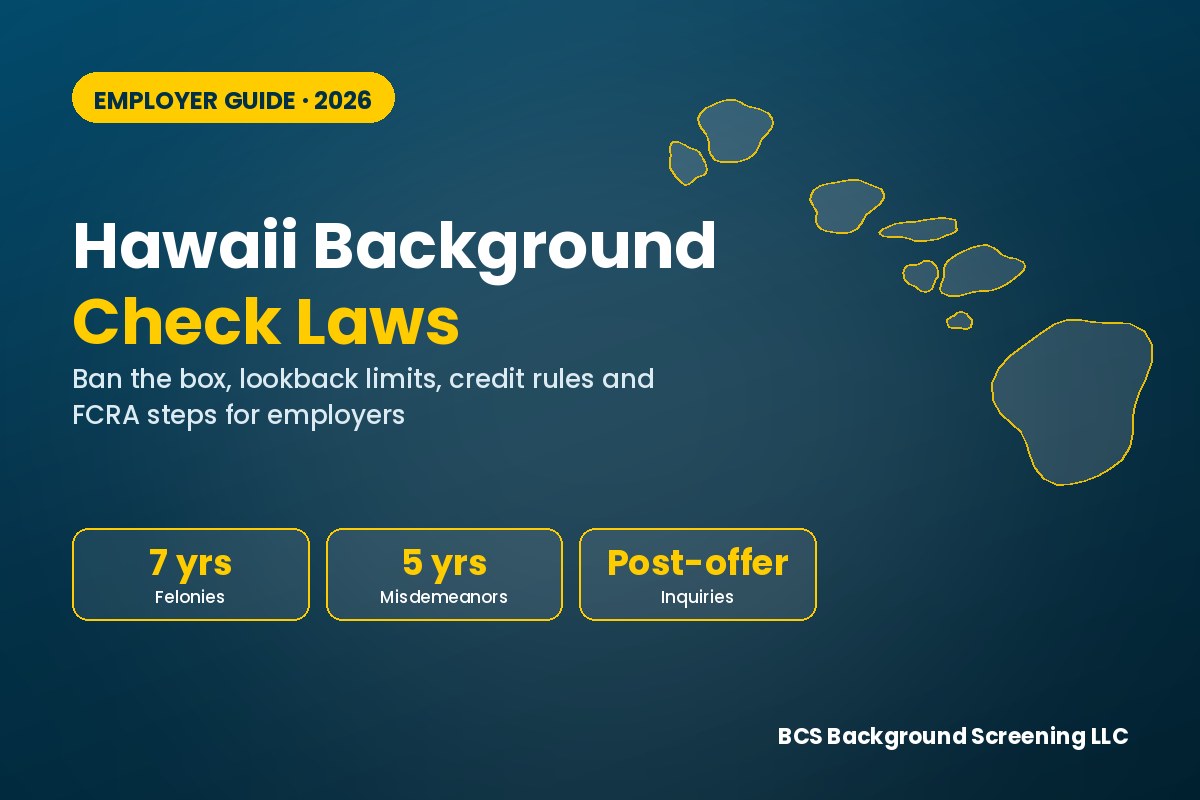
Hawaii Background Check Laws at a Glance
The table below maps each Hawaii screening rule to its statute and administering agency.
Use it as a quick reference before you order any employment background check.
| Topic | Hawaii Rule | Statute | Administering Agency |
|---|---|---|---|
| Ban the box | Conviction questions only after a conditional offer | HRS §378-2.5(b) | Hawaii Civil Rights Commission (HCRC) |
| Criminal lookback | Felonies 7 years, misdemeanors 5 years, incarceration excluded | HRS §378-2.5(c) | HCRC |
| Job relationship | Conviction must bear a rational relationship to the job | HRS §378-2.5(a) | HCRC |
| Arrest and court records | Protected basis; no arrest-only decisions | HRS §378-2(a)(1) | HCRC |
| Credit history | Post-offer only; must relate to a bona fide occupational qualification | HRS §378-2.7; §378-2(a)(8) | HCRC |
| State criminal records | Public conviction data; nonconviction data restricted | HRS Chapter 846 | Hawaii Criminal Justice Data Center (HCJDC), Department of the Attorney General |
| Arrest expungement | Expunged arrests may be reported as no record | HRS §831-3.2 | Attorney General / HCJDC |
| Driving records | Traffic abstracts from the state courts | FCRA, 15 U.S.C. §1681b | Hawaii State Judiciary |
| Drug testing | Licensed laboratories; confirm positive screens | HRS Chapter 329B | Hawaii Department of Health |
| Salary history | No questions about prior pay | HRS §378-2.4 | HCRC |
| Pay transparency | Job listings must show an hourly rate or salary range (50 or more employees) | HRS §378-2.8 | HCRC |
| Consumer reports | Disclosure, authorization and adverse action notices | FCRA, 15 U.S.C. §1681 et seq. | FTC and CFPB |
Hawaii has no general state version of the FCRA for employment screening. HRS Chapter 489P regulates consumer reporting agencies, yet it focuses on credit report security freezes.
Hawaii Ban-the-Box Law and Conviction Inquiries
What the statute says
Hawaii Revised Statutes §378-2.5 governs employer inquiries into conviction records.
First, it bars conviction questions until you extend a conditional offer of employment.
Second, it lets you withdraw that offer only for a conviction tied to the job’s duties.
Finally, the statute caps how far back you may look.
The Hawaii Civil Rights Commission administers and enforces this law statewide.
When you may ask about convictions
Start by removing every conviction question from applications and interview scripts.
Next, extend a written conditional offer before you order a criminal background check.
After the offer, you may ask about convictions and review the report.
The rational relationship test
Hawaii does not allow blanket bans on applicants with criminal records.
Instead, you must link a specific conviction to the duties of the position.
For example, a recent theft conviction may relate to a cash-handling role.
By contrast, an old petty misdemeanor rarely relates to an office job.
The EEOC arrest and conviction guidance also offers a useful framework for this review.
Hawaii Criminal Background Check Lookback Limits
Act 51 of 2020 shortened Hawaii’s lookback window from ten years to its current limits.
Today, HRS §378-2.5(c) sets the time limits below for most private employers.
Felony convictions you may consider
Misdemeanor convictions you may consider
Periods of incarceration do not count
FCRA limit on most non-conviction records
How incarceration time affects the count
The lookback clock stops while a person is incarcerated.
For example, take a 2016 felony with a four-year prison term.
Ten calendar years have passed, yet only six count toward the limit.
So, you may still consider that felony in 2026.
Applicants may also present evidence of an earlier release date to shorten the count.
How Hawaii limits work with the FCRA
The federal Fair Credit Reporting Act lets screening firms report convictions with no time limit.
Meanwhile, it caps most arrests and other non-conviction records at seven years.
Because Hawaii law is stricter, apply the 7-year and 5-year limits to every covered decision.
Our reports show the file date, disposition date and full sentence, so you can apply each limit correctly.
Arrest Records, Expungement and State Repository Rules
HRS §378-2(a)(1) makes arrest and court record a protected basis under Hawaii law.
Therefore, you cannot refuse to hire someone because of an arrest alone.
Pending charges and non-conviction outcomes also stay off-limits.
Expunged arrests under HRS §831-3.2
Adults arrested but not convicted may apply for an expungement order.
The Department of the Attorney General processes these requests through HCJDC.
In addition, Act 62 of 2024 created a state-initiated expungement pilot limited to Hawaii County.
It covers single-charge marijuana possession arrests before January 11, 2020 that ended without conviction.
After expungement, the person may state that no such arrest record exists.
Consequently, never ask applicants about sealed or expunged matters.
Hawaii’s statewide criminal repository
The Hawaii Criminal Justice Data Center maintains the state’s criminal history records.
Its public eCrim portal shows adult conviction information only.
Under HRS §846-9, nonconviction data goes only to authorized recipients.
Similarly, HRS §846-2.7 authorizes fingerprint checks for listed employers, such as care providers and schools.
Hawaii Credit Check Restrictions for Employers
HRS §378-2.7 limits how employers use credit history and credit reports.
Under HRS §378-2(a)(8), credit history must directly relate to a bona fide occupational qualification.
In addition, you may check credit only after a conditional offer of employment.
The HCRC enforces these credit rules alongside other Part I protections.
Who is exempt from Hawaii’s credit check limits
- Employers that federal or state law expressly permits or requires to check credit
- Managerial and supervisory positions, as the statute defines them
- Financial institutions with deposits insured by a federal agency
Even when an exemption applies, the FCRA disclosure and adverse action steps still apply.
Driving Records and Motor Vehicle Reports in Hawaii
In Hawaii, the State Judiciary issues official traffic abstracts, not a separate DMV.
Each abstract lists moving violations, resulting convictions and administrative license revocations.
However, parking and equipment violations do not appear.
By law, the courts keep at least ten years of moving violation history.
Because an abstract ordered through a screening firm is a consumer report, the FCRA applies.
Likewise, Hawaii’s conviction rules may apply when a record shows a criminal traffic offense, such as impaired driving.
For driving roles, order a Motor Vehicle Record after the conditional offer.
Other Hawaii Employment Screening Laws to Know
Salary history ban
HRS §378-2.4 bars questions about an applicant’s salary history.
Still, you may discuss the applicant’s pay expectations.
Drug and alcohol testing
HRS Chapter 329B requires licensed laboratories for substance abuse testing.
It also requires lab confirmation of positive on-site screens before you act.
In addition, you must give written notice of the substances tested.
Care-setting and school checks
Many healthcare, child care and elder care roles require fingerprint-based checks.
So, confirm whether a mandated check covers your role before you hire.
Pay transparency in job listings
In addition, HRS §378-2.8 requires pay transparency in job listings.
It applies to employers with 50 or more employees.
Each listing must disclose an hourly rate or salary range that reasonably reflects expected compensation.
However, the rule exempts internal transfers and promotions.
It also exempts public positions set by collective bargaining.
Act 203 of 2023 added this rule, effective January 1, 2024.
Social media password law
Hawaii also has a social media password law, HRS §487G-3.
It is part of the Uniform Employee and Student Online Privacy Protection Act (Act 39 of 2021).
Therefore, do not ask for social media passwords during hiring.
Four FCRA Steps for Every Hawaii Background Check
The FCRA applies to every Hawaii employer that uses a background screening company.
The FTC guide for employers explains each duty in detail.
- 1
Disclose
Give a standalone written disclosure that you will obtain a background report.
- 2
Authorize
Obtain the applicant’s written authorization before you order the report.
- 3
Pre-adverse action
Send a copy of the report and the Summary of Rights, then allow time to respond.
- 4
Adverse action
Send a final notice with the screening company’s contact details and dispute rights.
In Hawaii, order the criminal or credit report only after the conditional offer.
Who Enforces Hawaii Background Check Laws
The Hawaii Civil Rights Commission investigates complaints under HRS Chapter 378, Part I.
Notably, Act 56 of 2026 extended the complaint filing deadline to one year.
Previously, applicants had only 180 days to file.
As a result, a flawed screening decision now carries risk for twice as long.
Meanwhile, the FTC and CFPB enforce the federal FCRA.
Applicants may also sue in federal court for willful FCRA violations.
Hawaii Employment Screening from BCS Background Screening LLC
BCS Background Screening LLC helps Hawaii employers screen applicants quickly and lawfully.
Each search below supports your Hawaii compliance workflow.
Hawaii Real-Time Statewide Search
Current statewide conviction data for Hawaii applicants.
County Criminal Court Search
Researcher-verified records straight from county courts.
Nationwide Criminal Database
Broad multi-state coverage plus sex offender and watchlist checks.
Federal Criminal Search
Federal district court records for the U.S. District of Hawaii and beyond.
Motor Vehicle Records
Driving history for delivery, fleet and transport roles.
Mobile Applicant Screening
Applicants e-sign FCRA forms and submit data from any phone.
Every user account also includes optional Multiple Authentication Factor (MAF) for added login security.
Hawaii Employer Background Check Compliance Checklist
- Remove conviction questions from every application form.
- Extend a written conditional offer before any criminal or credit check.
- Provide a standalone FCRA disclosure and collect written authorization.
- Consider only felonies within 7 years and misdemeanors within 5 years.
- Exclude incarceration time when you count the lookback period.
- Document the rational relationship between any conviction and the job.
- Ignore arrests, pending charges and expunged records.
- Send pre-adverse and adverse action notices, and keep records for at least one year.
Hawaii Employment Screening Laws: Frequently Asked Questions
What law governs criminal background checks for employment in Hawaii?
Hawaii Revised Statutes §378-2.5 governs how employers ask about and use conviction records.
It bars conviction questions until a conditional job offer, and it requires a rational relationship to the job.
It also sets the lookback limits.
The Hawaii Civil Rights Commission administers and enforces the statute.
How far back can a Hawaii employer look at criminal convictions?
Under HRS §378-2.5(c), you may consider felony convictions from the most recent seven years.
For misdemeanors, the limit is the most recent five years.
Time the person spent incarcerated does not count toward either period.
Act 51 of 2020 set these limits, replacing the earlier ten-year window.
When can a Hawaii employer ask about an applicant’s criminal history?
You may ask only after you extend a conditional offer of employment.
You may then withdraw the offer only for a conviction that bears a rational relationship to the job.
However, some employers may run broader checks under federal or state law.
For example, banks and schools fall outside the timing rule.
Can Hawaii employers consider arrest records that did not lead to a conviction?
No. HRS §378-2(a)(1) lists arrest and court record as a protected basis for discrimination.
Therefore, you may not base a decision on an arrest, a pending charge or a dismissed case.
Also, under HRS §831-3.2, a person with an expunged arrest may lawfully state that no record exists.
Are employer credit checks legal in Hawaii?
Only in limited cases.
HRS §378-2.7 allows a credit check only after a conditional offer.
Also, credit history must relate to a bona fide occupational qualification.
Exemptions cover managerial and supervisory roles and banks with federally insured deposits.
They also cover employers that other laws require to check credit.
The HCRC enforces this rule.
Does Hawaii have its own version of the Fair Credit Reporting Act?
Hawaii has no general state equivalent of the FCRA for employment screening.
Instead, the federal FCRA, 15 U.S.C. §1681, governs every background report you buy from a screening company.
Meanwhile, HRS Chapter 489P regulates consumer reporting agencies, but it focuses on credit report security freezes.
The FTC and the CFPB enforce the federal FCRA.
How do Hawaii employers obtain an applicant’s driving record?
The Hawaii State Judiciary issues official traffic abstracts, which list moving violations, resulting convictions and administrative license revocations.
Each abstract costs $20 directly from the courts.
When you order a motor vehicle record through a screening company, the FCRA disclosure, authorization and adverse action steps apply.
Who enforces Hawaii background check laws, and how long do applicants have to file a complaint?
The Hawaii Civil Rights Commission enforces HRS Chapter 378, Part I, including the ban-the-box and credit rules.
Act 56 of 2026, effective May 28, 2026, extended the filing deadline to one year from the discriminatory act.
Previously, applicants had 180 days to file.
Screen Hawaii Applicants the Compliant Way
Open an account today and order your first Hawaii background check in minutes.
Our FCRA-compliant reports show every disposition, so your team can apply Hawaii law with confidence.
Disclaimer: This page provides general information about Hawaii background check laws, not legal advice. Laws change often, so consult qualified employment counsel before you act. Last reviewed October 2026 by BCS Background Screening LLC.