
Arkansas Background Check Laws for Employers: 2026 Compliance Guide
Arkansas background check laws add few limits on private employers. However, record sealing, drug test costs, and industry checks still carry real risk.
This guide explains the statutes, lookback limits, and state agencies Arkansas employers need to know before screening applicants.
- FCRA-compliant employment screening
- Real-time Arkansas statewide criminal court search
- No setup or monthly fees for card customers
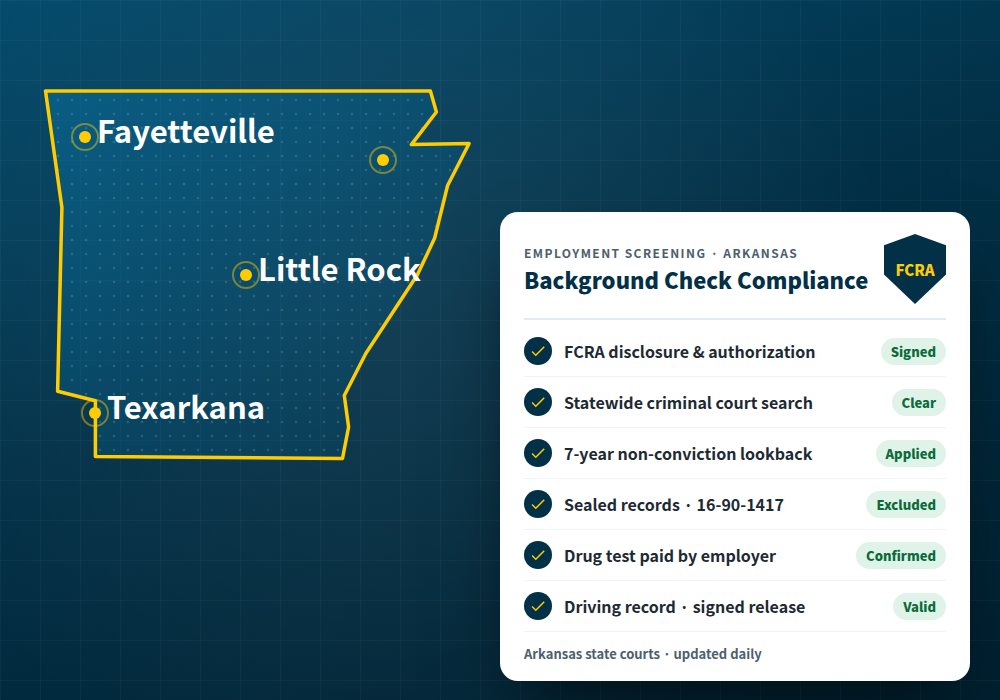
Arkansas Background Check Laws at a Glance
First, scan this table to see which rules apply to your hiring. Then, read the detailed sections below.
| Topic | Arkansas rule | Law | Administered by |
|---|---|---|---|
| State FCRA equivalent | None. The federal FCRA controls employment background checks. | 15 U.S.C. § 1681 et seq. | FTC and CFPB |
| Criminal record lookback | No state limit. The FCRA caps non-conviction records at seven years. | 15 U.S.C. § 1681c | FTC and CFPB |
| State criminal history release | State Police release convictions and felony arrests to requesters who pay the fee. | Ark. Code § 12-12-1506 | Arkansas State Police |
| Record sealing | Sealed conduct is treated as never having occurred. Applicants may deny it. | Ark. Code §§ 16-90-1401 to -1419 | Circuit and district courts; ACIC |
| Occupational licenses | Most disqualifying offenses stop counting after five clean years. | Ark. Code § 17-3-102 | State licensing entities |
| Ban the box | No statewide law for private employers. | None | Not applicable |
| Discrimination | Applies to employers with nine or more employees. Criminal history is not protected. | Ark. Code § 16-123-102 | Enforced through state courts |
| Credit checks | No state employment restriction. FCRA consent and notices apply. | 15 U.S.C. § 1681b | FTC and CFPB |
| Drug and medical exam costs | Employers must pay for required tests and give free report copies on request. | Ark. Code § 11-3-203 | Department of Labor and Licensing |
| Drug-free workplace program | A voluntary program for employers with workers’ comp coverage. | Ark. Code § 11-14-101 et seq. | Workers’ Compensation Commission |
| Medical marijuana | No bias based on patient status. Safety-sensitive jobs may be excluded. | Ark. Const. amend. 98 | Arkansas Department of Health |
| Driving records | Records are confidential. You need a signed release from the driver. | Ark. Code § 27-50-901 et seq. | DFA Office of Driver Services |
| Job references | Good-faith disclosures are immune with the employee’s written consent. | Ark. Code § 11-3-204 | Enforced through state courts |
| Social media | You cannot demand applicants’ social media passwords. | Ark. Code § 11-2-124 | Enforced through state courts |
| Data breach | Notify the Attorney General when a breach affects over 1,000 people. | Ark. Code § 4-110-105 | Arkansas Attorney General |
Does Arkansas Have Its Own FCRA?
No. Arkansas has not passed a state version of the Fair Credit Reporting Act. Instead, the federal FCRA governs every employment background check you order from a screening company.
The Federal Trade Commission and the Consumer Financial Protection Bureau enforce the law. You can read the full FCRA text on the FTC website.
In addition, the FTC guide Using Consumer Reports: What Employers Need to Know spells out each employer duty.
The Four FCRA Steps for Every Arkansas Hire
- 1
Disclose
Give a clear, standalone written disclosure before you order the report.
- 2
Authorize
Get written permission. Our mobile e-signature platform captures it securely.
- 3
Pre-adverse action
Send the report and the FCRA Summary of Rights before you decide.
- 4
Adverse action
After a final decision, send the adverse action notice with dispute rights.
How Far Back Do Background Checks Go in Arkansas?
Arkansas has no state lookback law for screening companies. Therefore, the federal FCRA sets the reporting limits.
Under 15 U.S.C. § 1681c, screeners cannot report arrest records, civil suits, or civil judgments older than seven years.
However, the seven-year cap does not cover criminal convictions. As a result, Arkansas convictions can appear no matter how old they are.
Arkansas does set a five-year rule for licenses. Under Ark. Code § 17-3-102, most listed offenses stop disqualifying applicants after five clean years.
Even so, older convictions deserve careful review. The EEOC arrest and conviction guidance asks you to weigh the offense, time elapsed, and job duties.
- 7 years
Non-conviction records
Arrests without conviction, civil suits, and civil judgments, unless the job pays $75,000 or more.
- No limit
Criminal convictions
Convictions stay reportable indefinitely, unless an Arkansas court seals the record.
- 5 years
License disqualifiers
Most non-violent, non-sexual disqualifying offenses stop counting for licenses after five years.
Arkansas Record Sealing and What It Means for Employers
Arkansas uses the Comprehensive Criminal Record Sealing Act of 2013, Ark. Code §§ 16-90-1401 to -1419. It replaced older expungement rules.
People file a uniform petition in the circuit or district court that handled the conviction. The prosecutor may object within 30 days, as Ark. Code § 16-90-1413 explains.
Once granted, the clerk sends the order to the Arkansas Crime Information Center. Agencies then remove the case from public indexes.
Applicants May Deny Sealed Records
Under Ark. Code § 16-90-1417, sealed conduct is deemed never to have occurred. Consequently, the person may state that no record exists.
Waiting periods are short, too. According to the Collateral Consequences Resource Center, many non-violent felonies qualify once the sentence ends.
Is Arkansas a Ban-the-Box State?
No. Arkansas has no statewide ban-the-box law for private employers. So, you may ask about convictions on your job application.
Also, the National Employment Law Project’s fair chance guide lists no Arkansas state or local policy.
The Arkansas Civil Rights Act covers employers with nine or more employees. Criminal history is not a protected class under that law.
Still, blanket conviction bans can create disparate impact risk under federal Title VII. Therefore, review each record against the specific job.
Drug Testing and Medical Marijuana in Arkansas
Arkansas makes employers pay for required tests. Under Ark. Code § 11-3-203, you cannot charge applicants for a drug test or medical exam.
You must also give a free copy of the report on written request. The Department of Labor and Licensing enforces this rule.
Meanwhile, Arkansas runs a voluntary drug-free workplace program under Ark. Code § 11-14-101 et seq. The Workers’ Compensation Commission administers it.
Medical Marijuana Protections
Amendment 98 bars discrimination based on a person’s status as a qualifying patient. However, employers may still test and keep drug-free policies.
In addition, you may exclude patients from written safety-sensitive positions. Wright Lindsey Jennings explains how to designate those jobs.
Credit Checks, Driving Records, and References in Arkansas
Employment Credit Checks
Arkansas does not restrict employment credit checks. Nevertheless, 15 U.S.C. § 1681b still requires written authorization first.
Also, keep credit checks job-related. Roles that handle cash, accounts, or sensitive data make the strongest case.
Motor Vehicle Records (MVRs)
The DFA Office of Driver Services keeps driving records confidential. Therefore, you need a signed release, valid for five years.
It offers three-year insurance, commercial, and lifetime history records. For CDL drivers, 49 C.F.R. § 391.23 requires a three-year record within 30 days of hire.
Job References
Under Ark. Code § 11-3-204, former employers enjoy immunity for good-faith references.
However, they need the worker’s signed written consent first. Baker Donelson’s Arkansas guide covers the consent form rules.
Industry-Specific Background Check Requirements in Arkansas
Several Arkansas laws require deeper screening for jobs that involve children, elders, or public trust.
Child Care Providers
Staff need state and FBI criminal checks, a sex offender registry check, and a Child Maltreatment Central Registry check.
Schools and Educators
Licensed and classified school staff need State Police, FBI, and maltreatment registry checks. The Division of Elementary and Secondary Education lists disqualifying offenses.
Elder and Home Care
Long-term care facilities, home health agencies, and hospices must run criminal history and registry checks on workers.
Licensed Occupations
Licensing boards apply a list of disqualifying offenses. Applicants can request a waiver based on rehabilitation and relevance.
E-Verify for State Employers
Since January 1, 2026, state employers must verify new hires through E-Verify. The Arkansas House summary confirms the scope.
In addition, contractors on state service contracts of $25,000 or more must certify they employ no unauthorized workers. However, Ark. Code § 19-11-105 does not require them to use E-Verify, and private employers have no mandate.
AI and Automated Decision Tools
No Arkansas law regulates private employers’ use of AI in hiring. However, Act 848 of 2025 requires public entities to adopt a written AI and automated-decision-tool policy. Under that policy, an authorized human employee makes any final decision.
Social Media Privacy
You may review public posts. However, you cannot demand passwords or friend access from applicants.
State Police Records
State checks show Arkansas convictions and felony arrests only. Therefore, add county, federal, and nationwide searches for full coverage.
Applicant Data Security
Protect the data you collect. When a breach affects over 1,000 people, notify the Attorney General within 45 days.
Screen Arkansas Applicants the Compliant Way
BCS Background Screening LLC helps Arkansas employers hire with confidence. We build every search around FCRA rules and Arkansas law.
Arkansas Real-Time Statewide Search
Real-time search of Arkansas circuit and district court felony and misdemeanor cases, updated daily.
County Criminal Court Searches
Direct searches of Pulaski, Benton, Washington, and Arkansas’s other county courts.
Federal Criminal Searches
Eastern and Western District of Arkansas federal court records that state searches miss.
Nationwide Background Check
SSN trace, national criminal database, sex offender registry, and government watchlists.
Motor Vehicle Records
Arkansas driving histories for delivery, trucking, sales, and CDL positions.
Mobile E-Signature Screening
Applicants e-sign FCRA disclosures and enter their own data from any phone.
Arkansas Background Check Compliance Checklist
Before you screen your next Arkansas applicant, confirm each item below.
- Use a standalone FCRA disclosure and collect written authorization.
- Confirm whether child care, school, or elder care rules apply to the role.
- Apply the FCRA seven-year rule and the $75,000 salary exception correctly.
- Never hold a sealed record against an applicant.
- Pay for every required drug test or medical exam yourself.
- Designate safety-sensitive positions in writing before you test.
- Collect a signed release before you request an Arkansas driving record.
- Review each conviction against the offense, time elapsed, and job duties.
- Send pre-adverse and adverse action notices, in that order.
- Compare rules for other states in our screening laws by state hub.
Arkansas Employment Screening Laws: FAQs
These answers name the governing statute, explain what it does, and identify the agency in charge.
Does Arkansas have a state version of the Fair Credit Reporting Act?
No. Arkansas has no state mini-FCRA. Instead, the federal Fair Credit Reporting Act, 15 U.S.C. § 1681 et seq., governs employment background checks.
The FTC and CFPB enforce it. Separately, Ark. Code § 12-12-1506 controls what the Arkansas State Police release from state criminal history files.
How far back can an Arkansas criminal background check go?
Arkansas has no state lookback law. Under the federal FCRA, 15 U.S.C. § 1681c, screeners cannot report non-conviction records older than seven years.
However, convictions have no time limit, and the cap lifts for jobs paying $75,000 or more. The FTC and CFPB enforce these limits.
Is Arkansas a ban-the-box state?
No. Arkansas has no statewide ban-the-box law for private employers, so you may ask about convictions on applications.
The Arkansas Civil Rights Act, Ark. Code § 16-123-101 et seq., covers employers with nine or more workers. It does not protect criminal history, and state courts enforce it.
Can Arkansas applicants deny sealed criminal records?
Yes. Under Ark. Code § 16-90-1417, sealed conduct is deemed never to have occurred. The person may state that no record exists.
Circuit and district courts grant sealing, and the Arkansas Crime Information Center updates state records. Exceptions cover criminal cases and certain licensing reviews.
Which Arkansas employers must run state-mandated background checks?
Child care providers need State Police, FBI, and Child Maltreatment Central Registry checks through the Department of Human Services.
Also, schools must screen staff under Ark. Code §§ 6-17-410 and 6-17-414. Elder care providers follow Ark. Code § 20-33-213.
Can Arkansas employers check driving records?
Yes, with a signed release. Ark. Code § 27-50-901 et seq. keeps driving records confidential. The DFA Office of Driver Services processes requests.
A driver’s release stays valid for five years. For CDL drivers, 49 C.F.R. § 391.23 requires a three-year record within 30 days of hire.
Who pays for drug tests, and can Arkansas employers test for marijuana?
Employers pay. Ark. Code § 11-3-203 bars charging applicants for required tests, and the Department of Labor and Licensing enforces it.
Amendment 98 protects medical marijuana patients from status-based bias. Still, you may test and exclude patients from safety-sensitive jobs.
Start Screening Arkansas Applicants Today
Open your free account in minutes, then pay only for the searches you order.
All user accounts offer optional Multiple Authentication Factor (MAF) security.
This page offers general information, not legal advice. Laws change, so consult Arkansas employment counsel before you act. Last reviewed October 2026.