
Arizona Background Check Laws for Employers: 2026 Compliance Guide
Arizona background check laws favor employers in many ways. However, record sealing, E-Verify, and fingerprint card rules still demand attention.
This guide explains the statutes, lookback limits, and state agencies Arizona employers need to know before screening applicants.
- FCRA-compliant employment screening
- Real-time Arizona statewide criminal court search
- No setup or monthly fees for card customers
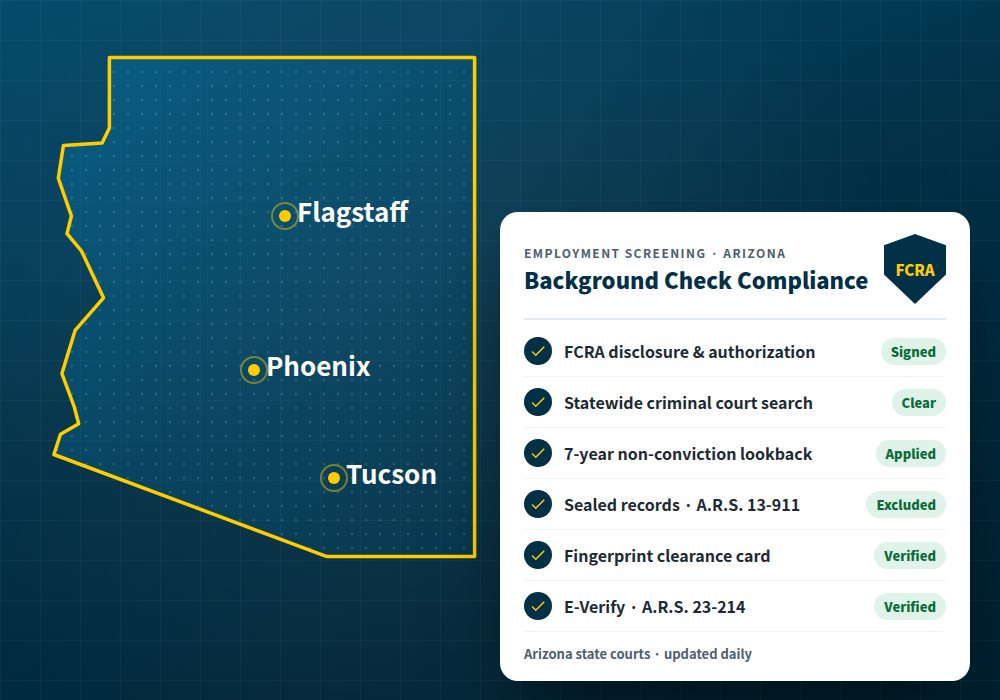
Arizona Background Check Laws at a Glance
First, scan this table to see which rules apply to your hiring. Then, read the detailed sections below.
| Topic | Arizona rule | Law | Administered by |
|---|---|---|---|
| State consumer reporting law | Covers report access, disputes, and agency liability. It sets no lookback limit. | A.R.S. §§ 44-1691 to 44-1697 | Enforced through civil lawsuits |
| Criminal record lookback | No state limit. The FCRA caps non-conviction records at seven years. | 15 U.S.C. § 1681c | FTC and CFPB |
| Record sealing | Applicants may deny sealed arrests and convictions on most job applications. | A.R.S. § 13-911 | Arizona courts |
| Set-aside convictions | DPS annotates the record but does not remove it. | A.R.S. § 13-905 | Arizona courts; Department of Public Safety |
| Marijuana expungement | Minor possession records can be expunged and denied. | A.R.S. § 36-2862 | Arizona courts |
| Ban the box | State agencies only. Phoenix, Tucson, and Pima County cover their own jobs. | Executive Order 2017-07 | State agencies; local governments |
| Negligent hiring | A prior conviction generally cannot prove negligent hiring. | A.R.S. § 12-558.03 | Arizona courts |
| Discrimination | Applies to employers with 15 or more employees. | A.R.S. § 41-1461 et seq. | Attorney General Civil Rights Division |
| E-Verify | Every Arizona employer must verify new hires. | A.R.S. § 23-214 | Attorney General; county attorneys |
| Fingerprint clearance cards | Required for many school, child care, and health care jobs. | A.R.S. § 41-1758.07 | Department of Public Safety |
| Credit checks | No state employment restriction. FCRA consent and notices apply. | 15 U.S.C. § 1681b | FTC and CFPB |
| Driving records | MVD sells three-year and five-year records for permissible uses. | A.R.S. § 28-455; 18 U.S.C. § 2721 | ADOT Motor Vehicle Division |
| Drug testing | A compliant written policy protects employers from many lawsuits. | A.R.S. §§ 23-493.04, 23-493.06 | Enforced through the courts |
| Medical marijuana | Cardholders are protected unless impaired or using at work. | A.R.S. § 36-2813 | Arizona Department of Health Services |
| Data breach | Notify affected people within 45 days of determining a breach. | A.R.S. § 18-552 | Arizona Attorney General |
Does Arizona Have Its Own FCRA?
Partly. Arizona has a consumer reporting statute, A.R.S. §§ 44-1691 to 44-1697. It covers reports used for employment purposes.
The state law gives applicants access to their files. Moreover, A.R.S. § 44-1694 requires agencies to answer disputes in writing within 30 days.
However, the federal FCRA still sets most employer duties. The FTC guide for employers spells out each step. You can also read the full FCRA text.
The Four FCRA Steps for Every Arizona Hire
- 1
Disclose
Give a clear, standalone written disclosure before you order the report.
- 2
Authorize
Get written permission. Our mobile e-signature platform captures it securely.
- 3
Pre-adverse action
Send the report and the FCRA Summary of Rights before you decide.
- 4
Adverse action
After a final decision, send the adverse action notice with dispute rights.
How Far Back Do Background Checks Go in Arizona?
Arizona has no state lookback law for screening companies. Therefore, the federal FCRA sets the reporting limits.
Under 15 U.S.C. § 1681c, screeners cannot report arrest records, civil suits, or civil judgments older than seven years.
However, the seven-year cap does not cover criminal convictions. As a result, Arizona convictions can appear no matter how old they are.
Sealing changes the picture. Once a court seals a record, the applicant may lawfully deny it on most job applications.
Even so, older convictions deserve careful review. The EEOC arrest and conviction guidance asks you to weigh the offense, time elapsed, and job duties.
- 7 years
Non-conviction records
Arrests without conviction, civil suits, and civil judgments, unless the job pays $75,000 or more.
- No limit
Criminal convictions
Convictions stay reportable indefinitely, including set-asides, unless a court seals or expunges them.
- 2–10 years
Sealing wait times
People can petition to seal records after two to ten years, depending on the offense class.
Arizona Record Sealing, Set-Asides, and Expungement
Since December 31, 2022, Arizonans can petition to seal criminal case records. A.R.S. § 13-911 sets the rules.
Waiting periods run from two years for minor misdemeanors to ten years for Class 2 and 3 felonies. The Arizona Judicial Branch sealing page explains the petition process.
After sealing, applicants may state they were never arrested or convicted. Consequently, you should not rely on a sealed record.
Set-Asides Work Differently
Under A.R.S. § 13-905, a court can set aside a conviction. Still, DPS only annotates the record and may not remove it.
Meanwhile, A.R.S. § 36-2862 lets people expunge minor marijuana possession records. They may then deny the arrest entirely.
Is Arizona a Ban-the-Box State?
Only for public jobs. In November 2017, Governor Doug Ducey signed Executive Order 2017-07 for state agencies.
According to Troutman’s legal analysis, agencies wait until after an initial interview to ask about criminal history.
Several local governments act on their own jobs, too. For example, Phoenix delays the question until the finalist interview under Administrative Regulation 2.81. Tucson, Tempe, Glendale, Pima County, and Maricopa County adopted similar policies.
No Arizona law bans the box for private employers. So, you may ask about convictions on your application.
Negligent Hiring Protection Under A.R.S. § 12-558.03
Many employers fear lawsuits after hiring someone with a record. Fortunately, Arizona law offers strong protection.
Under A.R.S. § 12-558.03, an employer is not liable merely for hiring a person with a prior conviction.
In negligent hiring cases, the conviction generally cannot even come into evidence.
However, the shield has limits. A conviction can come in if the employer knew of it. It must also relate directly to the job and the injury.
Credit Checks, Driving Records, and Drug Testing in Arizona
Employment Credit Checks
Arizona does not restrict employment credit checks. Nevertheless, 15 U.S.C. § 1681b still requires written authorization first.
Also, keep credit checks job-related. Roles that handle cash, accounts, or sensitive data make the strongest case.
Motor Vehicle Records (MVRs)
The ADOT Motor Vehicle Division offers three-year uncertified and five-year certified driving records.
Requesters need a permissible use under A.R.S. § 28-455, which mirrors the federal DPPA.
For CDL drivers, 49 C.F.R. § 391.23 requires a three-year record within 30 days of hire.
Drug and Alcohol Testing
Arizona protects employers who follow a compliant written testing policy under A.R.S. § 23-493.04.
Adult marijuana use is legal, yet A.R.S. § 36-2851 preserves drug-free workplaces. However, A.R.S. § 36-2813 protects medical cardholders.
Ogletree’s employer brief covers policy updates.
Industry-Specific Background Check Requirements in Arizona
Several Arizona laws require deeper screening for jobs that involve children, vulnerable adults, or public trust.
Fingerprint Clearance Cards
Many school, child care, and health care workers need a Level I card. Verify status through the DPS Clearance Card Section, not a photocopy.
E-Verify for All Employers
The Legal Arizona Workers Act requires every employer to verify new hires. Keep records for three years or the length of employment.
Civil Rights Compliance
The Arizona Civil Rights Act bans hiring bias by employers with 15 or more workers. Harassment claims reach employers with one.
Medical Marijuana Cardholders
You cannot reject cardholders for status or a positive test alone. On-site use or impairment at work removes that protection.
Sealed Record Exceptions
Law enforcement, courts, and child welfare employers may still consider sealed records. Fingerprint card reviews also see them.
Second Chance Hiring
Hiring someone with a conviction does not, by itself, create negligent hiring liability. Certificates of second chance extend similar protection.
City of Phoenix Jobs
Phoenix reviews city applicants’ records at the finalist stage. It generally looks back seven years before the job offer.
Applicant Data Security
After a breach, notify affected people within 45 days. When a breach affects over 1,000 people, A.R.S. § 18-552 also requires notice to the Attorney General.
Screen Arizona Applicants the Compliant Way
BCS Background Screening LLC helps Arizona employers hire with confidence. We build every search around FCRA rules and Arizona law.
Arizona Real-Time Statewide Search
Real-time search of Arizona state court felony and misdemeanor cases, updated daily.
County Criminal Court Searches
Direct searches of Maricopa, Pima, and Arizona’s other 13 county courts.
Federal Criminal Searches
U.S. District Court for the District of Arizona records that state searches miss.
Nationwide Background Check
SSN trace, national criminal database, sex offender registry, and government watchlists.
Motor Vehicle Records
Arizona driving histories for delivery, fleet, sales, and CDL positions.
Mobile E-Signature Screening
Applicants e-sign FCRA disclosures and enter their own data from any phone.
Arizona Background Check Compliance Checklist
Before you screen your next Arizona applicant, confirm each item below.
- Use a standalone FCRA disclosure and collect written authorization.
- Verify fingerprint clearance cards online with DPS for covered roles.
- Apply the FCRA seven-year rule and the $75,000 salary exception correctly.
- Never hold a sealed or expunged record against an applicant.
- Document how each conviction relates to the job to preserve A.R.S. § 12-558.03 protection.
- Review each conviction against the offense, time elapsed, and job duties.
- Run every new hire through E-Verify and keep the records.
- Update your drug policy for medical marijuana cardholders.
- Send pre-adverse and adverse action notices, in that order.
- Compare rules for other states in our screening laws by state hub.
Arizona Employment Screening Laws: FAQs
These answers name the governing statute, explain what it does, and identify the agency in charge.
Does Arizona have a state version of the Fair Credit Reporting Act?
Partly. A.R.S. §§ 44-1691 to 44-1697 regulate consumer reporting agencies, including reports used for employment. They cover file access, 30-day dispute answers, and agency liability.
Consumers enforce the state law through civil lawsuits. Meanwhile, the federal FCRA sets most employer duties, and the FTC and CFPB enforce it.
How far back can an Arizona criminal background check go?
Arizona has no state lookback law. Under the federal FCRA, 15 U.S.C. § 1681c, screeners cannot report non-conviction records older than seven years.
However, convictions have no time limit, and the cap lifts for jobs paying $75,000 or more. The FTC and CFPB enforce these limits.
Is Arizona a ban-the-box state?
Only for public jobs. Executive Order 2017-07 requires state agencies to delay criminal history questions until after an initial interview.
Phoenix, Tucson, and Pima County apply similar policies to their own jobs. No Arizona law covers private employers.
Can Arizona applicants deny sealed criminal records?
Yes, in most cases. Under A.R.S. § 13-911, a person with a sealed record may say they were never arrested or convicted.
Arizona courts grant sealing after waiting periods of two to ten years. Exceptions apply to fingerprint clearance cards and law enforcement, court, and child welfare jobs.
Are Arizona employers liable for hiring someone with a criminal record?
Generally, no. A.R.S. § 12-558.03 says an employer is not liable merely for hiring a person with a prior conviction.
However, Arizona courts may admit a known conviction. That applies when it relates directly to the job and the injury.
Which Arizona jobs require a fingerprint clearance card?
Many school, child care, and health care positions require one under A.R.S. § 41-1758.07. Certain offenses permanently bar a Level I card.
The Arizona Department of Public Safety issues cards, which stay valid for six years. Employers must verify card status online with DPS.
Can Arizona employers drug test for marijuana?
Yes. A.R.S. § 23-493.04 protects employers with compliant written policies, and A.R.S. § 36-2851 preserves drug-free workplaces.
However, A.R.S. § 36-2813 bars penalizing medical cardholders for a positive test alone. The Arizona Department of Health Services regulates both marijuana programs.
Start Screening Arizona Applicants Today
Open your free account in minutes, then pay only for the searches you order.
All user accounts offer optional Multiple Authentication Factor (MAF) security.
This page offers general information, not legal advice. Laws change, so consult Arizona employment counsel before you act. Last reviewed October 2026.