
613a Letter: FCRA Section 613 Notice Explained, With a Sample
A 613a letter tells an applicant that a screening agency reported public record information to an employer.
The screening agency sends it. With us, it goes out when the employer requests it.
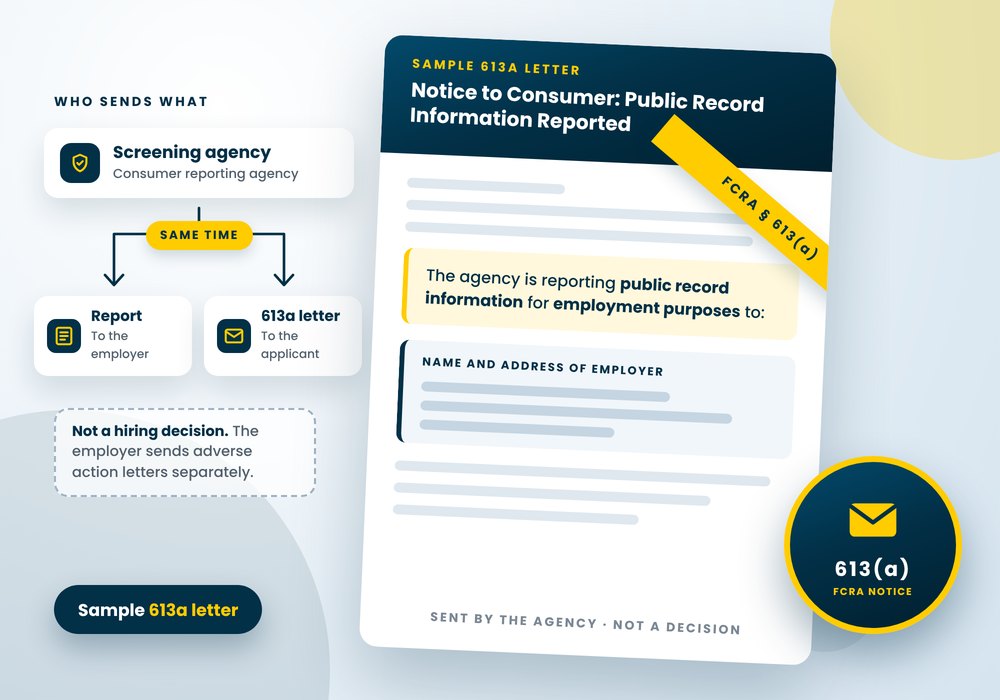
Sample only: This letter is a starting point, not legal advice. Therefore, ask your legal counsel to review it before use.
What Is a 613a Letter?
A 613a letter is a notice that a consumer reporting agency (CRA) sends to a job applicant.
Specifically, it says the agency is reporting public record information to an employer.
For example, that information may include a criminal record, a civil judgment or a tax lien.
The name comes from Section 613(a) of the Fair Credit Reporting Act (15 U.S.C. § 1681k).
Employers also call it a 613 letter, a 613 notice or a contemporaneous notice.
Importantly, the letter does not announce a hiring decision.
613a Letter or Strict Procedures: The Two FCRA Options
Section 613 gives a screening agency two ways to comply. Consequently, the agency must meet at least one of them.
Option 1: Send the 613a letter
- The agency tells the applicant that it is reporting public record information.
- Also, the letter names the person who receives the report and gives that person’s address.
- The agency sends the letter at the time it reports the information.
- However, the letter does not confirm that the record is accurate.
Option 2: Maintain strict procedures
- The agency keeps strict procedures so the public record information is complete and up to date.
- For arrests, convictions, suits, liens and judgments, the report must show the current public record status.
- In practice, many agencies confirm a database hit at the county court first.
- Consequently, the applicant may never receive a 613a letter.
Where these rules come from
First, the statute sets out both options (15 U.S.C. § 1681k).
Additionally, FTC staff wrote that Section 613 imposes its duties on consumer reporting agencies (FTC advisory opinion).
Moreover, a federal court read the two options as alternatives (Troutman Pepper on Henderson v. Infomart).
However, California requires strict procedures for these reports (Cal. Civ. Code § 1786.28).
Therefore, a letter alone does not satisfy California background check laws.
What a 613a Letter Must Include
The statute asks for very little. However, a few additions make the letter clearer for the applicant.
Required by the statute
- A statement that the agency is reporting public record information.
- The name of the person who receives the report.
- Also, that person’s address.
- Finally, delivery at the time the agency reports the information.
Helpful additions
- The agency’s name, mailing address and telephone number.
- How the applicant can request a copy of the file.
- Also, how to dispute incomplete or inaccurate information.
- A statement that the agency does not make the hiring decision.
- Finally, a copy of the Summary of Your Rights.
However, leave the details of the record out of the letter. The statute requires only the fact that the agency reported them.
Sample 613a Letter
Read the full sample below. In addition, each blank line shows where the agency adds its details.
Notice to Consumer: Public Record Information Reported for Employment Purposes
Sample 613a letter
Confidential. To be read by the addressee only.
Date:
To:
Dear :
(“the Agency”) is a consumer reporting agency. The Agency sends you this notice under Section 613(a)(1) of the federal Fair Credit Reporting Act, 15 U.S.C. § 1681k(a)(1).
The Agency is now reporting public record information about you for employment purposes. This information may include criminal records or other public records, and it may be adverse to you. The Agency is reporting it to:
Company name:
Company address:
Company contact name, phone and email:
This company requested the report for employment purposes. It has certified that it will use the report to evaluate you for employment, promotion, reassignment or retention.
This notice is not a decision about your application or your employment. The Agency does not make hiring decisions, and your background check may still be in process. If the company plans to take adverse action based on the report, the law requires it to give you a copy of the report and a summary of your rights first.
You may request a copy of the information in your file. You may also dispute any information that you believe is incomplete or inaccurate. The Agency will investigate your dispute at no charge to you.
To request your file or to start a dispute, contact the Agency at:
Agency name:
Mailing address:
Toll-free telephone:
Email or website:
Enclosure: A Summary of Your Rights Under the Fair Credit Reporting Act.
Sincerely,
Name and title, for the Agency
– End of Document –
Sample letter by BCS Background Screening LLC. Updated October 2026.
613a Letter vs. Adverse Action Letters
Three different notices can follow a background check. Therefore, use this table to tell them apart.
| Notice | Who sends it | When | What it says |
|---|---|---|---|
| 613a letter | The consumer reporting agency. With us, at the employer’s request. | At the time it reports the public record information. | The agency reported public record information, and it names the recipient. |
| Pre-adverse action notice | The employer. | Before it takes adverse action based on the report. | The employer may act on the report. It also includes the report and the Summary of Rights. |
| Adverse action notice | The employer. | After it makes the final decision. | The decision, the agency’s contact details and the applicant’s dispute rights. |
Need the employer notices? Then, review our sample adverse action letters.
Additionally, find every sample in our background check forms library.
What to Do If You Receive a 613a Letter
- 1
Read Who Received the Report
First, note the company named in the letter.
It ordered your background check for employment purposes.
- 2
Ask for a Copy of Your File
Next, contact the agency listed in the letter.
Then, request the information in your file.
- 3
Dispute Errors Quickly
Dispute any record that looks wrong or incomplete.
Moreover, the agency must investigate free of charge, usually within 30 days.
- 4
Tell the Employer
Finally, let the employer know about your dispute.
Remember, the letter itself is not a rejection.
Did BCS Background Screening LLC prepare your report? Then, call (800) 661-0278 or email support@usabackground.com.
How Employers Should Handle a 613a Letter
- 1
Verify Database Hits at the Court
Criminal databases can be out of date.
Therefore, confirm each hit at the county court first.
- 2
Request a 613a Letter Only If Needed
Alternatively, some employers request a 613a letter for an unverified record.
However, we do not recommend it in place of verification.
- 3
Wait Before You Decide
Next, give the applicant time to respond or dispute.
A database hit alone should not end a candidacy.
- 4
Follow the Adverse Action Process
Finally, send the pre-adverse action notice before any rejection.
Then, send the final adverse action notice.
Our nationwide criminal database search costs $17 and works as a locator.
Then, a county criminal court search confirms each record for $18 plus court fees, if any.
613a Letter: FAQs
What is a 613a letter?
It is a notice from a consumer reporting agency to a job applicant.
Specifically, it says the agency reported public record information to an employer.
Who sends a 613a letter?
The consumer reporting agency sends it.
At BCS Background Screening LLC, our system emails it when the employer requests it.
In contrast, the employer sends the pre-adverse action and adverse action notices.
Is a 613a letter an adverse action notice?
No. A 613a letter does not announce a hiring decision.
Instead, it tells the applicant that the agency reported public record information.
Does every background check trigger a 613a letter?
No. An agency may maintain strict procedures instead of sending the letter.
Moreover, the rule covers only public record information that could hurt a job prospect.
Also, we email a 613a letter only when the employer requests one.
Does a 613a letter satisfy California law?
No, not by itself. California requires agencies to maintain strict procedures for these reports.
Therefore, confirm the details with your legal counsel.
Start Screening With Records You Can Verify Today
Open your free account with BCS Background Screening LLC in minutes. Then, pay only for the searches you order.
All user accounts offer optional Multiple Authentication Factor (MAF) security.
Disclaimer: This sample letter offers general information, not legal advice. BCS Background Screening LLC does not assume responsibility for its compliant content. FCRA and EEOC rules change, so consult legal counsel before you send a 613a letter.