
Adverse Action Letter: The FCRA Two-Step Process for Employers
An adverse action letter tells an applicant that a background check led to a negative hiring decision.
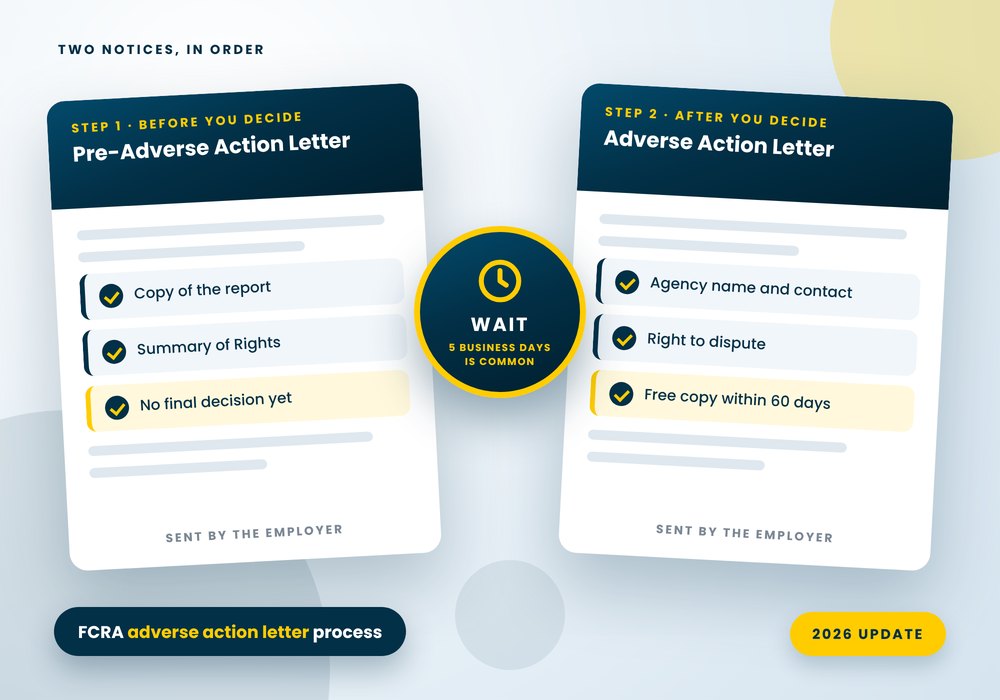
The FCRA requires two notices, in order. Therefore, follow the steps and the 2026 updates below.
General information: This page is not legal advice. Therefore, ask your legal counsel to review your adverse action process.
What Is an Adverse Action Letter?
An adverse action letter tells an applicant or employee about a negative employment decision.
Specifically, the decision rests in whole or in part on a background check report.
For example, adverse action includes a denied job, promotion, reassignment or retention.
The Fair Credit Reporting Act (FCRA) requires two notices (FTC guide for employers).
First, the employer sends a pre-adverse action letter with a copy of the report.
Then, after a fair wait, the employer sends the final adverse action letter.
Consequently, the applicant gets a real chance to correct errors.
The Adverse Action Letter Process, Step by Step
- 1
Send the Pre-Adverse Action Letter
First, send this notice before you make a final decision.
Include the report and the Summary of Rights.
- 2
Wait a Reasonable Time
Next, give the applicant time to review the report.
Five business days is common practice.
- 3
Review Any Response
Then, read any dispute or explanation.
Also, document your individualized assessment.
- 4
Send the Adverse Action Letter
Finally, send the final notice if you still decline.
It names the screening agency and explains the applicant’s rights.
You can automate both letters within your secure account. Our system generates a pre-populated letter with the FCRA wording and a copy of the report.
Then, you print and mail it to your applicant for $5.00 per letter.
What Each Adverse Action Letter Must Include
Each notice has its own required contents (15 U.S.C. § 1681m). Therefore, check both lists before you send.
Pre-adverse action letter
- A copy of the background check report you relied on.
- A copy of the current Summary of Your Rights from the CFPB.
- Also, a clear statement that you have not made a final decision.
- Finally, how and by when the applicant can respond.
Adverse action letter
- The name, address and phone number of the screening agency.
- A statement that the agency did not make the decision and cannot explain it.
- Notice of the right to dispute the accuracy or completeness of the report.
- Notice of the right to a free copy of the report within 60 days.
- Additionally, the credit score details, if you used a credit score.
The FCRA requires the first two items in the pre-adverse list. In contrast, the last two are good practice.
The final notice may be oral, written or electronic. However, a written letter gives you proof.
How Long to Wait Before the Final Adverse Action Letter
The FCRA sets no exact waiting period.
However, FTC staff called a wait of five business days reasonable (FTC staff letter).
Moreover, the right wait can change with the facts.
Meanwhile, several states and cities set their own minimums, as the table below shows.
Therefore, use the longest period that applies to the applicant.
Still, you need not hold the job open forever.
After a fair chance to respond, you may fill the position.
Adverse Action Letter Rules: What Changed for 2026
Federal steps stayed the same. However, several agencies, states and cities changed the details.
| When | What changed | What to do |
|---|---|---|
| Oct. 6, 2026 | The EEOC sent a rule to White House review to rescind its 2012 criminal record guidance (Ogletree Deakins). | Keep your individualized assessment. The guidance stays in place until the EEOC publishes a final rule. |
| Aug. 10, 2026 | San Francisco amended its Fair Chance Ordinance (Morgan Lewis). | Acknowledge an applicant’s evidence within 14 days. Then, send any final notice within 30 days. |
| July 1, 2026 | Washington’s amended Fair Chance Act took effect for employers with 15 or more employees (Littler). | Identify the record in a pre-adverse notice. Then, hold the job open at least two business days. |
| Jan. 6, 2026 | Philadelphia amended its fair chance hiring ordinance (Jackson Lewis). | Give written notice with the report. Then, allow 10 business days to respond. |
| Since March 20, 2024 | The CFPB requires its updated Summary of Your Rights form. | Replace older copies. They list outdated agency addresses. |
Washington employers with fewer than 15 employees must comply by January 1, 2027.
State and City Adverse Action Rules That Add Steps
Fair chance laws add their own notices when a criminal record drives the decision. Consequently, the FCRA letters alone may fall short.
| Place | Minimum time to respond | Added steps |
|---|---|---|
| California | At least 5 business days. Add 5 more for a documented dispute. | Send a preliminary notice with the report. Then, send a written final notice. |
| Los Angeles County | At least 5 business days. Add 10 more for a dispute or new evidence. | Send both notices by mail and email. Also, complete a second assessment. |
| San Francisco | Seven days. | Acknowledge evidence within 14 days. Then, decide within 30 days. |
| New York City | At least 5 business days. | Give the Fair Chance Notice, your written analysis and the record. |
| Illinois | At least 5 business days. | Send a preliminary notice with the conviction report and your reasoning. |
| Washington | At least 2 business days. | Name the record. Then, document your reasoning in a written decision. |
| Philadelphia | 10 business days. | Give written notice of rights, the report and response instructions. |
These local notices do not replace the FCRA letters. Instead, send both sets or combine them carefully.
Additionally, check every location in our employment screening laws by state guide.
Individualized Assessment and the Adverse Action Letter
Since 2012, the EEOC has urged an individualized assessment before a criminal record denial (EEOC guidance).
Specifically, the assessment weighs the offense, the time passed and the job.
However, the EEOC moved in October 2026 to rescind that guidance.
The change is not final yet.
Moreover, it would not change the FCRA or any state or local law.
Therefore, keep the assessment in your process.
You can also send an assessment form with the pre-adverse action letter.
Where the 613a Letter Fits in Adverse Action
A 613a letter is a different notice.
Sometimes, a database search shows a possible derogatory record.
At that point, nobody has verified the record at the county court.
Some employers then ask us to email the applicant a 613a letter.
However, we do not recommend that procedure.
Instead, confirm the record with a county criminal court search first.
Sample Adverse Action Letters and Related Guides
Sample Pre-Adverse Action Letter
First, review the notice that goes out before any final decision.
Employment Screening Laws by State
Finally, check the federal, state and city rules for each place you hire.
Adverse Action Letter: FAQs
What is an adverse action letter?
It is the notice an employer sends after a negative decision based on a background check.
Moreover, the FCRA requires a pre-adverse action letter before it.
What is the difference between a pre-adverse and an adverse action letter?
The pre-adverse action letter comes first and includes the report and the Summary of Rights.
In contrast, the adverse action letter announces the final decision and the applicant’s rights.
How long must an employer wait between the two letters?
The FCRA sets no exact period.
However, five business days is common practice, and some states and cities require more.
What must an adverse action letter include?
It must name the screening agency and give its address and phone number.
Additionally, it must say the agency did not make the decision.
Finally, it must explain the right to dispute and to request a free report within 60 days.
Is a 613a letter the same as a pre-adverse action letter?
No. A 613a letter is a separate notice that comes from the screening agency.
Therefore, it never replaces either adverse action notice.
Send Compliant Adverse Action Letters From Your Account
Open your free account with BCS Background Screening LLC in minutes. Then, pay only for the searches you order.
All user accounts offer optional Multiple Authentication Factor (MAF) security.
Disclaimer: This page offers general information, not legal advice. BCS Background Screening LLC does not assume responsibility for its compliant content. FCRA, EEOC and local rules change, so consult legal counsel before you take adverse action.