
Federal Civil Court Search: Lawsuits in All 94 U.S. District Courts
A federal civil court search reveals lawsuits filed in U.S. District Courts nationwide.
Additionally, each report includes the full docket of dates and events.
Use it to vet executives, business partners, and key hires.
What Can I Find in a Federal Civil Court Search?
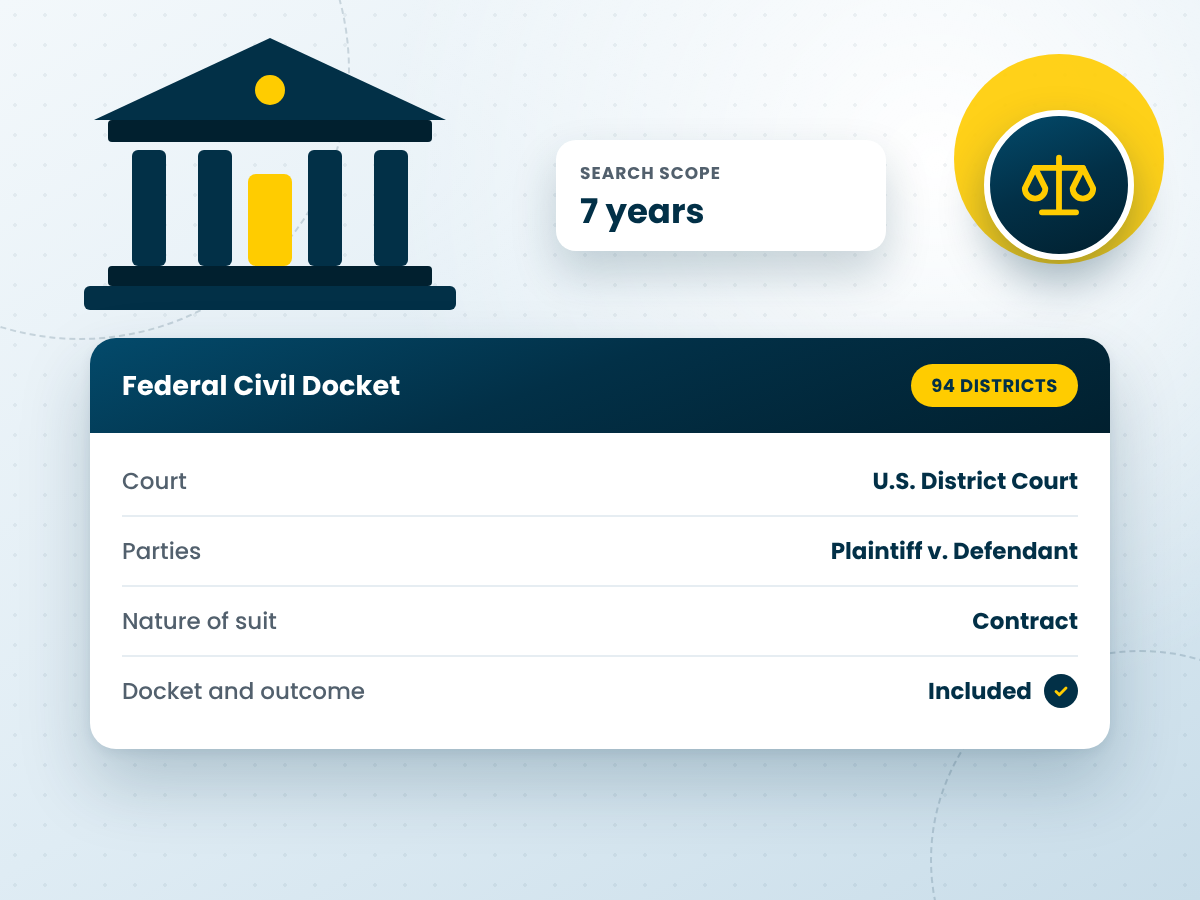
We search civil case records from all United States District Court (USDC) jurisdictions.
Specifically, the search finds civil lawsuits where federal law applies.
Court and Case Number
First, the report names the district court and the case number.
Plaintiffs and Defendants
It also lists every party, so you see your subject’s role.
Nature of Suit and Cause
Additionally, it states the case type and the federal law at issue.
Filing and Closing Dates
The report then shows when the case began and ended.
Assigned Judges
Furthermore, it identifies the district judge and any magistrate judge.
Full Docket and Outcome
Finally, the docket lists all dates and events through the final disposition.
What Can I Use a Federal Civil Records Search For?
A criminal search shows only part of a person’s court history.
In contrast, a federal civil records search reveals disputes over money, contracts, and conduct.
Therefore, employers and businesses use it for higher-risk decisions.
- Screen executives and candidates with financial authority.
- Vet a potential business partner before you sign.
- Review vendors, contractors, and franchise applicants.
- Find fraud, contract, and intellectual property lawsuits.
- Spot repeated litigation that relates to the role.
Additionally, the docket shows how each case ended.
As a result, you can separate a dismissed claim from a judgment.
Use caution with protected activity
Federal law protects people who assert workplace rights.
Specifically, Title VII bars retaliation against employees and applicants.
Therefore, never reject a candidate because they sued a former employer for discrimination.
Instead, weigh only case types that relate to the job.
Types of Civil Cases Found in U.S. District Courts
Federal courts hear civil cases that arise under federal law.
Additionally, they hear disputes between citizens of different states over $75,000.
Every case carries an official nature of suit code, so you can classify it quickly.
| Category | Codes | Examples of cases |
|---|---|---|
| Contract | 110–196 | Insurance, marine, negotiable instruments, student loan recovery, stockholder suits, franchise |
| Real Property | 210–290 | Land condemnation, foreclosure, rent, lease and ejectment, torts to land |
| Torts | 310–385 | Personal injury, medical malpractice, product liability, fraud, truth in lending |
| Civil Rights | 440–448 | Voting, employment, housing, Americans with Disabilities Act, education |
| Prisoner Petitions | 463–560 | Habeas corpus, motions to vacate sentence, prison conditions, civil rights |
| Forfeiture and Penalty | 625–690 | Drug-related seizure of property, other forfeitures and penalties |
| Labor | 710–791 | Fair Labor Standards Act, labor and management relations, Family and Medical Leave Act, ERISA |
| Immigration | 462–465 | Naturalization applications, other immigration actions |
| Bankruptcy | 422–423 | Bankruptcy appeals and withdrawals of reference |
| Property Rights | 820–880 | Copyrights, patents, trademarks, trade secrets |
| Social Security | 861–865 | Disability, retirement, and supplemental security income claims |
| Federal Tax Suits | 870–871 | Tax cases with the United States as a party, IRS third-party suits |
| Other Statutes | 375–950 | False Claims Act, antitrust, banking, racketeering, consumer credit, securities, environmental matters, Freedom of Information Act |
How We Match Federal Civil Records, and What the FCRA Limits
Federal civil filings follow different rules than criminal records.
Therefore, review every result with the points below in mind.
Fed. R. Civ. P. 5.2
Name-Match Basis Only
Federal civil records rarely contain a date of birth or a full SSN.
In fact, court rules limit filings to partial identifiers.
Consequently, researchers report these cases on a name-match basis only.
15 U.S.C. § 1681c(a)(2)
Seven-Year Reporting Limit
The FCRA generally bars reporting civil suits and judgments older than seven years.
However, a longer statute of limitations can extend that period.
15 U.S.C. § 1681c(b)(3)
The $75,000 Salary Exception
The seven-year limit does not apply to higher-paid positions.
Specifically, it exempts jobs with an annual salary of $75,000 or more.
For employment purposes, you also need a standalone FCRA disclosure and a signed authorization.
Additionally, follow pre-adverse and adverse action steps before you act on a record.
Federal vs. State Civil Court Searches
The nation’s 94 U.S. district courts are the federal trial courts.
They recorded 303,563 civil filings in fiscal year 2025.
However, most civil lawsuits begin in state courts instead.
For example, state courts handle most contract, landlord, and small claims disputes.
Therefore, a federal search alone can miss local litigation.
Add a County Civil Court search for each county where your subject lived or worked.
Together, both searches give you a fuller view of civil litigation history.
Related civil and financial searches
- State-level lawsuitsCounty Civil Court search, $30
- Bankruptcy filingsNationwide bankruptcies, $10
- Liens and judgmentsStatewide bankruptcies, tax liens, and judgments, $15
- Federal crimesFederal criminal search, $17
How to Order a Federal Civil Court Search
Open an Account
First, open a business account online.
You can also add optional Multiple Authentication Factor (MAF) security for every user.
Collect the Authorization
Next, provide the FCRA disclosure and collect a signed authorization.
This step applies whenever you screen for employment.
Enter the Subject’s Name
Then enter the full legal name and any former names.
Because matching relies on names, accuracy matters.
Review the Docket
Finally, review each case and its docket in your secure account.
Sample Federal Civil Report
This excerpt comes from our fictitious sample report.
U.S. District Court, Eastern District of California
Docket highlights
01/21/2012: Plaintiff requested withdrawal of the action.
03/16/2012: Court dismissed the action without prejudice.
Researcher note
Record below was found on a NAME MATCH BASIS ONLY as Federal CIVIL records do not contain DOB/SSN identifiers.
Sample only. The parties and case shown are fictitious. View the full sample report.
Federal Civil Court Search Questions and Answers
What is a federal civil court search?
A federal civil court search looks for lawsuits filed in U.S. District Courts.
It covers all 94 federal districts nationwide.
Additionally, each record includes the full docket of dates and events.
What cases show up in a federal civil records search?
The search finds civil cases where federal law applies.
For example, it reports contract, civil rights, labor, and intellectual property suits.
It also finds disputes between citizens of different states over $75,000.
How far back does a federal civil court search go?
Our standard search covers seven years.
Moreover, the Fair Credit Reporting Act generally limits civil suits and judgments to seven years.
However, that limit does not apply to positions paying $75,000 or more a year.
How do you match a federal civil case to my subject?
Federal civil records rarely contain a date of birth or a full Social Security number.
Therefore, researchers report these cases on a name-match basis only.
Consequently, you should compare case details against what you know about the subject.
Does this search include state court lawsuits?
No, this search covers federal district courts only.
However, most civil lawsuits begin in state courts.
Therefore, add a County Civil Court search for full coverage.
Order a Federal Civil Court Search Today
Open your account now, and review federal lawsuits before your next key decision.
Questions? Call (800) 661-0278 or email support@usabackground.com.
BCS Background Screening LLC provides this page for general information only, and it is not legal advice. Therefore, consult qualified counsel about your Fair Credit Reporting Act and anti-retaliation duties.