
Alaska Background Check Laws for Employers: 2026 Compliance Guide
Alaska background check laws add few state rules. However, federal FCRA duties and strict health care barrier crimes still apply.
This guide explains the statutes, lookback limits, and state agencies Alaska employers need to know before screening applicants.
- FCRA-compliant employment screening
- Real-time Alaska statewide criminal court search
- No setup or monthly fees for card customers
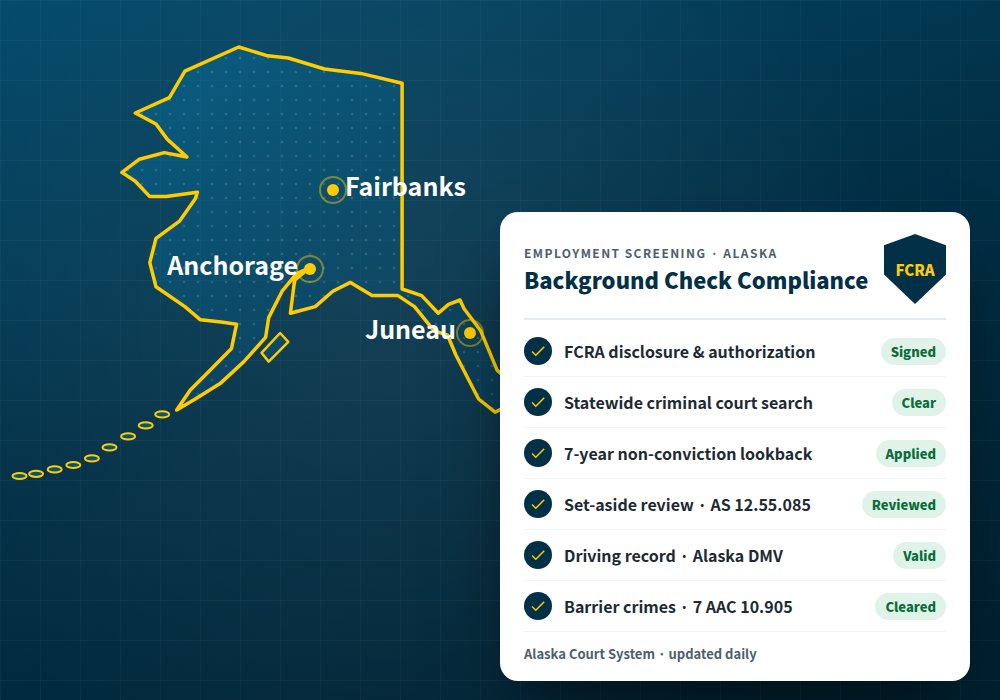
Alaska Background Check Laws at a Glance
First, scan this table to see which rules apply to your hiring. Then, read the detailed sections below.
| Topic | Alaska rule | Law | Administered by |
|---|---|---|---|
| State FCRA equivalent | None. The federal FCRA controls employment background checks. | 15 U.S.C. § 1681 et seq. | FTC and CFPB |
| Criminal record lookback | No state limit. The FCRA caps non-conviction records at seven years. | 15 U.S.C. § 1681c | FTC and CFPB |
| State criminal history release | Anyone may get past conviction information. Non-conviction data stays restricted. | AS 12.62.160; 13 AAC 68 | Department of Public Safety |
| Online court records | CourtView drops acquittals and most dismissals after 60 days. | AS 22.35.030 | Alaska Court System |
| Set-aside convictions | A set-aside is not an expungement. The conviction record remains. | AS 12.55.085 | Alaska Court System |
| Record sealing | Only mistaken identity or false accusation records qualify. | AS 12.62.180 | Department of Public Safety |
| Ban the box | No statewide law for private or public employers. | None | Not applicable |
| Discrimination | Covers employers with one or more employees. Criminal history is not a protected class. | AS 18.80.220 | Alaska State Commission for Human Rights |
| Health care barrier crimes | Permanent, 10-year, 5-year, and 3-year bars for covered workers. | AS 47.05.300–.390; 7 AAC 10.905 | Departments of Health and Family & Community Services |
| National fingerprint checks | Listed jobs and licenses require FBI fingerprint checks. | AS 12.62.400 | Department of Public Safety |
| Credit checks | No state restriction. FCRA consent and notices still apply. | 15 U.S.C. § 1681b | FTC and CFPB |
| Driving records | Records are confidential. You need the driver’s consent. | 18 U.S.C. § 2721; 49 C.F.R. § 391.23 | Alaska Division of Motor Vehicles; FMCSA |
| Drug testing | A compliant written policy shields employers from many lawsuits. | AS 23.10.600–.699 | Enforced through the courts |
| Marijuana | Employers need not accommodate use and may restrict it. | AS 17.38.220 | Marijuana Control Board |
| Job references | Good-faith job performance disclosures carry legal immunity. | AS 09.65.160 | Enforced through the courts |
Does Alaska Have Its Own FCRA?
No. Alaska has not passed a state version of the Fair Credit Reporting Act. Instead, the federal FCRA governs every employment background check you order from a screening company.
The Federal Trade Commission and the Consumer Financial Protection Bureau enforce the law. You can read the full statute on the FTC’s Fair Credit Reporting Act page.
In addition, the FTC guide Using Consumer Reports: What Employers Need to Know spells out each employer duty.
Alaska does regulate one step, though. AS 12.62.160 controls what the Alaska Department of Public Safety releases from its criminal history repository.
The Four FCRA Steps for Every Alaska Hire
- 1
Disclose
Give a clear, standalone written disclosure before you order the report.
- 2
Authorize
Get written permission. Our mobile e-signature platform captures it securely.
- 3
Pre-adverse action
Send the report and the FCRA Summary of Rights before you decide.
- 4
Adverse action
After a final decision, send the adverse action notice with dispute rights.
How Far Back Do Background Checks Go in Alaska?
Alaska has no state lookback law for screening companies. Therefore, the federal FCRA sets the reporting limits.
Under 15 U.S.C. § 1681c, screeners cannot report arrest records, civil suits, or civil judgments older than seven years.
However, the seven-year cap does not cover criminal convictions. As a result, Alaska convictions can appear no matter how old they are.
Alaska adds its own twist online. Under AS 22.35.030, the Alaska Court System removes acquittals and most dismissals from CourtView after 60 days.
Even so, older convictions deserve careful review. The EEOC arrest and conviction guidance asks you to weigh the offense, time elapsed, and job duties.
- 60 days
CourtView removal
Acquittals and most dismissals leave the public court website 60 days after disposition.
- 7 years
Non-conviction records
Arrests without conviction, civil suits, and civil judgments, unless the job pays $75,000 or more.
- No limit
Criminal convictions
Convictions stay reportable indefinitely, including convictions a court later set aside.
Set-Asides, Sealing, and Record Relief in Alaska
Alaska has no general expungement law. Instead, judges use suspended imposition of sentence, often called an SIS.
Under AS 12.55.085, a court can set aside the conviction after the person completes probation.
However, a set-aside does not erase the record. According to the Collateral Consequences Resource Center, licensing boards may still treat it as a conviction.
When Alaska Records Are Sealed
Under AS 12.62.180, DPS seals records only for mistaken identity or false accusation. The person must prove it beyond a reasonable doubt.
Meanwhile, a 2026 law, HB 239, lets people shield old marijuana possession convictions. Marijuana Moment reports it covers possession under one ounce by adults 21 or older.
In addition, Alaska Administrative Rule 40(a)(15) removes those cases from the public CourtView index. However, the rule applies only when the case holds no other conviction.
Is Alaska a Ban-the-Box State?
No. Alaska has no statewide ban-the-box law for private or public employers. So, you may ask about convictions on your job application.
Also, the National Employment Law Project’s fair chance guide lists no Alaska statewide policy. However, the Municipality of Anchorage delays criminal-history questions for its own positions until after a conditional offer (AO 2015-096).
Alaska’s Human Rights Law, AS 18.80.220, bans bias based on race, sex, disability, and other traits. Criminal history is not on that list.
Still, the Alaska State Commission for Human Rights enforces the law against employers with even one employee. Blanket criminal record bans can create disparate impact risk under federal Title VII.
Alaska Barrier Crimes for Health Care and Human Services
Alaska imposes its own lookback periods on one group of workers. The Background Check Program under AS 47.05.300–.390 screens people who work for state-licensed providers.
The Department of Health Background Check Program runs fingerprint checks through the New Alaska Background Check System.
Regulation 7 AAC 10.905 then sorts disqualifying offenses by how long they bar employment.
Credit Checks, Driving Records, and Drug Testing in Alaska
Employment Credit Checks
Alaska does not restrict employment credit checks. Nevertheless, 15 U.S.C. § 1681b still requires written authorization first.
Also, keep credit checks job-related. Roles that handle cash, accounts, or sensitive data make the strongest case.
Motor Vehicle Records (MVRs)
The Alaska Division of Motor Vehicles treats driving records as confidential. Therefore, you need the driver’s consent.
The DMV offers full, insurance, and CDL employment records. The federal Driver’s Privacy Protection Act also limits access.
For CDL drivers, 49 C.F.R. § 391.23 requires a three-year record within 30 days of hire.
Drug and Alcohol Testing
Alaska’s testing law, AS 23.10.600–.699, protects employers who follow a compliant written policy.
Marijuana is legal for adults. Even so, AS 17.38.220 lets you ban workplace use. Baker Donelson’s Alaska guide covers the details.
Industry-Specific Background Check Requirements in Alaska
Several Alaska laws require deeper screening for jobs that involve children, patients, or public trust.
Health Care and Human Services
Covered providers must clear workers through fingerprint checks. Barrier crimes can disqualify applicants permanently or for set periods.
Teachers and Educators
Teacher certificate applicants submit fingerprints. The Teacher Certification Office accepts only DPS and FBI reports.
Licensed and Listed Jobs
This law authorizes national fingerprint checks for nurses, school bus drivers, security guards, and marijuana licensees.
Sex Offender Registry
Search the Alaska Sex Offender/Child Kidnapper Registry before you hire for roles near children or vulnerable adults.
CourtView Searches
CourtView offers free statewide case lookups. However, the court warns employers to verify identity before taking adverse action.
Job Reference Immunity
Former employers may share job performance information in good faith. False or malicious statements lose that protection.
Marijuana Policies
Adult marijuana use is legal. Still, you may keep drug-free workplace policies and refuse to accommodate use.
Applicant Data Security
Protect the personal data you collect. After a breach, notify affected Alaskans under the Personal Information Protection Act.
Screen Alaska Applicants the Compliant Way
BCS Background Screening LLC helps Alaska employers hire with confidence. We build every search around FCRA rules and Alaska law.
Alaska Statewide Criminal Search
Real-time search of Alaska Court System felony and misdemeanor cases, updated daily.
Federal Criminal Searches
U.S. District Court for the District of Alaska records that state searches miss.
Nationwide Background Check
SSN trace, national criminal database, sex offender registry, and government watchlists.
Out-of-State County Searches
New to Alaska? Search the county courts where your applicant lived before.
Motor Vehicle Records
Alaska driving histories for delivery, fleet, sales, and CDL positions.
Mobile E-Signature Screening
Remote applicants e-sign FCRA disclosures and enter their own data from any phone.
Alaska Background Check Compliance Checklist
Before you screen your next Alaska applicant, confirm each item below.
- Use a standalone FCRA disclosure and collect written authorization.
- Check whether your provider falls under the state Background Check Program.
- Apply the FCRA seven-year rule and the $75,000 salary exception correctly.
- Treat set-aside convictions carefully, and credit completed probation in your review.
- Confirm identity with date of birth before acting on a CourtView result.
- Review each conviction against the offense, time elapsed, and job duties.
- Get written consent before you request an Alaska driving record.
- Adopt a written drug testing policy that meets AS 23.10.620.
- Send pre-adverse and adverse action notices, in that order.
- Compare rules for other states in our screening laws by state hub.
Alaska Employment Screening Laws: FAQs
These answers name the governing statute, explain what it does, and identify the agency in charge.
Does Alaska have a state version of the Fair Credit Reporting Act?
No. Alaska has no state mini-FCRA. Instead, the federal Fair Credit Reporting Act, 15 U.S.C. § 1681 et seq., governs employment background checks.
The FTC and the Consumer Financial Protection Bureau enforce it. Separately, AS 12.62.160 limits what the Alaska Department of Public Safety releases from state criminal history files.
How far back can an Alaska criminal background check go?
Alaska has no state lookback law. Under the federal FCRA, 15 U.S.C. § 1681c, screeners cannot report non-conviction records older than seven years.
However, convictions have no time limit, and the cap lifts for jobs paying $75,000 or more. The FTC and CFPB enforce these limits.
Is Alaska a ban-the-box state?
No. Alaska has no statewide ban-the-box law, so employers may ask about convictions on applications.
The Alaska Human Rights Law, AS 18.80.220, does not list criminal history as a protected trait. The Alaska State Commission for Human Rights enforces that law.
Can a set-aside conviction appear on an Alaska background check?
Yes. AS 12.55.085 lets a court set aside a conviction after probation, but the record is not erased.
Alaska offers no general expungement. Under AS 12.62.180, the Department of Public Safety seals records only for mistaken identity or false accusation.
Which Alaska employers must run fingerprint background checks?
Providers licensed or paid by the Department of Health must screen workers under AS 47.05.300–.390. Barrier crimes in 7 AAC 10.905 set permanent or timed disqualifications.
Also, AS 12.62.400 authorizes national fingerprint checks for listed jobs, such as teachers and school bus drivers. The Department of Public Safety processes them.
Can Alaska employers check driving records?
Yes, with the driver’s consent. The Alaska Division of Motor Vehicles keeps records confidential. The federal Driver’s Privacy Protection Act, 18 U.S.C. § 2721, also applies.
For CDL drivers, FMCSA rule 49 C.F.R. § 391.23 requires a three-year driving record within 30 days of hire.
Can Alaska employers drug test applicants, including for marijuana?
Yes. AS 23.10.600–.699 protects employers from many lawsuits when they follow a compliant written testing policy.
Marijuana is legal for adults, but AS 17.38.220 lets employers restrict use. The Alaska Marijuana Control Board regulates the marijuana program itself.
Start Screening Alaska Applicants Today
Open your free account in minutes, then pay only for the searches you order.
All user accounts offer optional Multiple Authentication Factor (MAF) security.
This page offers general information, not legal advice. Laws change, so consult Alaska employment counsel before you act. Last reviewed October 2026.